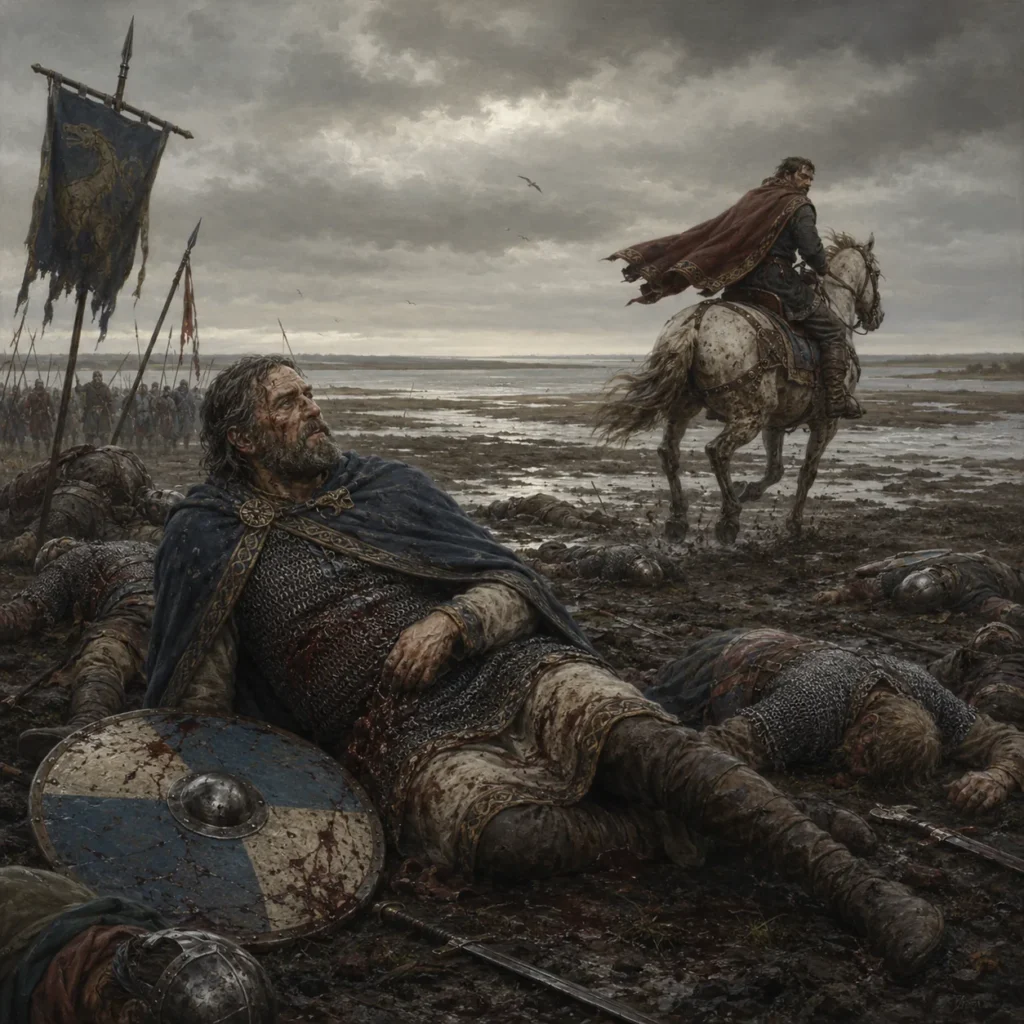
The Battle of Maldon and the Choice at the Causeway
In 991, beside a tidal causeway in Essex, Byrhtnoth held the stronger position. A Viking force had raided the English coast before occupying Northey Island, which the tide separated from the mainland. When the water withdrew, only a narrow crossing connected the island to the western bank of the River Blackwater.
Byrhtnoth’s men blocked that crossing. A few defenders could hold back a much larger force, so patience offered the safest strategy: contain the Vikings and deny them room to deploy and wait.
Yet Byrhtnoth allowed the Vikings to cross. In The Battle of Maldon, their spokesman asks for enough ground to form a battle line, and the ealdorman grants it. The poet connects that decision with one disputed Old English word: ofermod. Was Byrhtnoth acting from courage, pride or a fatal excess of spirit? That question drives the poem.
The English lost the battle, and Byrhtnoth fell. Some warriors fled, while others remained beside their dead lord. Their courage could no longer change the outcome. However, it could still determine how they met defeat.
Only 325 lines of The Battle of Maldon survive. Even so, the fragment compresses a world of competing duties: loyalty and judgment, bravery and vanity, honour and ruin. Its deepest question is not simply whether Byrhtnoth made the right choice. Instead, the poem asks what remains of choice when strategy has failed, escape is still possible and character is all that is left.
England and the Viking Raids of 991
England in 991 was not at peace. King Æthelred II had inherited the political order built by his father, Edgar, but renewed Viking attacks now threatened the coast. According to the Anglo-Saxon Chronicle, a fleet of ninety-three ships had already attacked Folkestone, Sandwich and Ipswich before the battle at Maldon. The Chronicle names its leader only as Olaf; historians have often identified him with the future Norwegian king Olaf Tryggvason, although that identification remains uncertain.
Byrhtnoth had served as ealdorman of Essex for more than three decades. He was probably an older and experienced commander. Later tradition also remembered him as exceptionally tall. An eighteenth-century account of the opening of his tomb at Ely reported a headless skeleton measuring six feet nine inches, but no contemporary source confirms that height.
At Northey Island, Byrhtnoth placed his army on the mainland side of the causeway. The tide restricted the Viking advance, while the narrow crossing favoured the defenders. Tactically, the advantage belonged to the English.
Ofermod: Courage or Destructive Pride?
The Viking messenger first demanded tribute in exchange for peace. Byrhtnoth answered with a forceful refusal. So far, his response fits the expected role of a lord defending his land.
What follows is much harder to explain. Byrhtnoth draws his men back and gives the enemy enough space to cross, deploy and fight on open ground. At line 89, the poet says that he conceded too much land for his ofermod.
Ofermod resists a neat translation. It can suggest pride, arrogance or an excess of spirit. J. R. R. Tolkien treated the word as a clear moral criticism: Byrhtnoth’s pride led him to sacrifice the tactical advantage and, with it, the lives of his men. Other scholars, including E. B. Irving and George Clark, have argued for a more sympathetic reading shaped by heroic honour and the desire to force a decisive battle.
Nevertheless, the poem’s wording leans toward criticism. Ofermod also appears in Old English religious poetry, where it can describe sinful pride. More importantly, the Maldon poet says that Byrhtnoth allowed the enemy too much land. The phrase judges the result even if it does not reveal every motive behind the decision.
Here lies the poem’s first lesson. Courage faces danger, but wise courage still judges the ground. Pride, by contrast, can make caution look like cowardice. The same outward action may resemble bravery in both cases; motive and consequence expose the difference.
Leadership Before the Battle
Before the fatal decision, the poem gives us a quieter scene. The two armies face each other across the water, and the tide controls the terms of engagement. Byrhtnoth waits, orders his ranks and holds the line.
That pause matters. He does not need to perform urgency simply to prove that he commands. Instead, he observes the ground and occupies the position his duty requires. His stillness shows discipline, not passivity.
Modern crises often create pressure to act at once. The Battle of Maldon offers a sharper standard: action matters only when judgment directs it. Old English poetry often praises ellen, a word that can carry the senses of courage, zeal and active resolve. Yet resolve without judgment may become recklessness. Byrhtnoth’s tragedy begins when disciplined waiting gives way to a choice that the poem marks as excessive.
Comitatus and the Loyalty of Byrhtnoth’s Men
Once the fighting begins, Byrhtnoth suffers mortal wounds. His death destroys the English chain of command, and the tactical situation collapses. At that point, retreat offers the best chance of survival.
Some men take it. The poet names the deserters and condemns their flight, especially Godric, who escapes on Byrhtnoth’s horse. From a distance, other warriors mistake the rider for their lord leaving the field, and the confusion deepens the defeat.
Others choose to remain. Their decision expresses the reciprocal bond between a lord and his retainers, often described by the modern Latin term comitatus. The lord offered protection, gifts and status; the warrior owed service and loyalty. Therefore, leaving after Byrhtnoth’s death would mean more than abandoning a lost battle. It would break the bond that defined each retainer’s public identity.
The poet preserves that loyalty through a sequence of speeches. Ælfwine recalls promises made on the mead-bench and declares that he will avenge his lord or die. Leofsunu refuses to retreat even one foot. Dunnere calls on every warrior who intends to avenge Byrhtnoth to cast aside fear for his own life.
These speeches do not create courage from nothing. Rather, they bring earlier promises into the present. Each man must decide whether words spoken in safety still bind him when keeping them may cost his life.
Byrhtwold’s Speech and the Will to Endure
Near the surviving end of The Battle of Maldon, the old retainer Byrhtwold speaks the poem’s most famous lines:
Hige sceal þe heardra, heorte þe cēnre,
mōd sceal þē māre, þē ūre mægen lȳtlað.
Will must be the harder, heart the keener,
spirit must be the greater, as our strength grows less.
Byrhtwold offers no false hope. He knows that his lord lies dead and that the English cannot recover the field. Consequently, his words do not promise victory. They define the inner response required by worsening circumstances.
The opening word, hige, refers to thought, mind or purpose. Here it carries the force of resolve: the mind directed toward action. Mōd likewise reaches beyond modern English ‘mood’; it can mean spirit, courage or force of mind. As physical mægen diminishes, Byrhtwold demands that inward resolve increase.
Tolkien found in this tradition what he called the northern theory of courage: the will to resist even when ultimate defeat appears certain. The idea also shaped his response to The Battle of Maldon in The Homecoming of Beorhtnoth Beorhthelm’s Son. Readers may hear a similar heroic pattern in The Lord of the Rings, although Tolkien did not identify Byrhtwold’s speech as the direct source of any single scene.
The distinction matters. Byrhtwold does not celebrate Byrhtnoth’s earlier tactical mistake. Instead, he answers the ruin that now surrounds him. The ealdorman’s ofermod helps create the disaster; the retainer’s hige determines how he will meet it.
What The Battle of Maldon Teaches About Courage
The surviving manuscript breaks off before the battle ends. History supplies the result: the English were defeated, Byrhtnoth died and Æthelred’s government paid 10,000 pounds of silver after the campaign. The payment recorded for 991 became an early example of the tribute later known as Danegeld.
Monks carried Byrhtnoth’s body to Ely, where he had supported the abbey. The Liber Eliensis, written nearly two centuries later, says that the community replaced his missing head with a ball of wax before burial. Because that account belongs to Ely’s later institutional memory, we should treat the detail cautiously rather than as contemporary testimony.
The poem endures because it does more than commemorate a defeat. First, it tests the judgment of a powerful leader. Then it exposes the cost of his decision. Finally, it watches ordinary retainers choose between survival and loyalty after victory has become impossible.
For that reason, The Battle of Maldon offers no simple celebration of heroic death. It sets two kinds of courage beside each other. Byrhtnoth risks everything when he does not need to; Byrhtwold stands firm when no good options remain. One decision may arise from excessive pride, while the other turns loyalty into deliberate action.
The tide still gives the poem its governing image. Water covers the causeway, then withdraws and reveals a choice. Once the crossing opens, character becomes visible. Strength may fail, plans may collapse and outcomes may lie beyond control. Yet the poem insists that judgment matters before the crisis and resolve matters after it.
Will must be the harder.
Next:
Follow the battle stage by stage in the illustrated guide: from the tidal crossing and the English defence of the causeway to Byrhtnoth’s death, desertion and the doomed resistance of the men who remained.
Explore the language behind the poem in the FREE WULFCRÆFT Old English Glossary, including words that open new ways of reading early English literature.
Start a discussion in the comments
Notes and Sources
1. The Anglo-Saxon Chronicle, Manuscript A, s.a. 991, records the fleet’s size and its route from Folkestone to Sandwich and Ipswich before Maldon. See Michael Swanton, trans. and ed., The Anglo-Saxon Chronicle (1996). The identification of the Chronicle’s Olaf with Olaf Tryggvason remains debated.
2. The report that Byrhtnoth’s skeleton measured six feet nine inches derives from an account of the tomb’s 1769 opening. Because the surviving record is later and second-hand, the measurement is best treated as tradition rather than settled fact.
3. Ofermod appears at line 89: þe se eorl ongan for his ofermode / alyfan landes to fela laþre þeode (‘then the earl began, because of his ofermod, to allow too much land to the hostile people’). See Donald Scragg, ed., The Battle of Maldon (1991), and Helmut Gneuss, ‘The Battle of Maldon 89: Byrhtnoth’s ofermod Once Again,’ Studies in Philology 73.2 (1976), 117-137. (No Affiliation)
4. J. R. R. Tolkien’s argument appears in ‘The Homecoming of Beorhtnoth Beorhthelm’s Son’ (1953). (No Affiliation) For contrasting approaches, see George Clark, ‘The Battle of Maldon: A Heroic Poem,’ Speculum 43.1 (1968), 52-71, and later scholarship on heroic conduct and ofermod.
5. Byrhtwold’s speech occurs at lines 312-315. The translation in this article is WULFCRÆFT’s, prepared with reference to Scragg’s edition. The following lines identify the dead lord directly: ‘Here lies our leader, all hewn down, a good man in the dust.’
6. The wax replacement for Byrhtnoth’s missing head appears in the Liber Eliensis, compiled in the twelfth century. It preserves Ely’s memory of its benefactor rather than an eyewitness account of the burial.
Read next
Grendel and the Kin of Cain: Beowulf’s Monster GenealogyWhy does Beowulf trace Grendel’s ancestry to Cain? Biblical history, the Flood and a giant-made sword reveal a monster shaped by violence, exile and broken kinship.
Be the first to leave a thought on this essay.
Comments are held for review before they appear.