Why the poem traces its monster back to Cain
Grendel enters Beowulf as a creature of the moors: a night-stalker who hates the sound of human joy. Before the poet describes his body, however, he gives us something stranger—his family history.
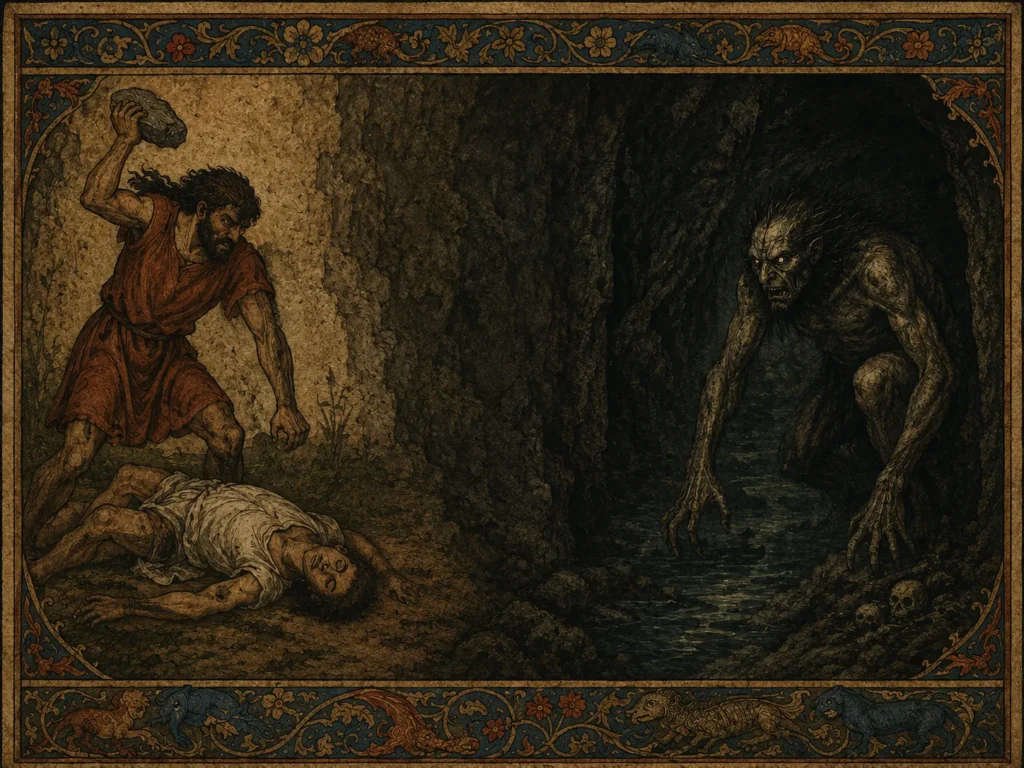
Grendel belongs to the line of Cain, the first man in the Hebrew Bible to kill another person, his brother Abel.
This claim creates a problem. Genesis never says that Cain fathered monsters. If Cain’s descendants lived before Noah, they should also have perished in the Flood. A sword-hilt later found beneath the water seems to deepen the difficulty by describing giants destroyed by the same catastrophe.
Why, then, does the poet connect Grendel with Cain?
Cain in Genesis
The story begins in Genesis 4. Cain and Abel, the first sons of Adam and Eve, bring offerings to God. When Abel’s offering is favoured, Cain’s resentment hardens into violence. He leads his brother into the field and kills him.
God’s judgement is not immediate execution but a life of restless separation. Cain is cursed from the ground that received Abel’s blood and condemned to wander. He fears that anyone who finds him will kill him, so God marks him, not simply as a sign of shame, but also to prevent the cycle of vengeance from beginning again.
For an early medieval Christian reader, Cain was more than the first murderer. He was the first destroyer of kinship: a brother who turned against his brother, severed himself from the human family, and entered a life of exile.
The Christian World of Beowulf
Beowulf survives in a single manuscript copied around the year 1000, within a Christian culture steeped in biblical narratives, commentary, homilies, and retellings. The poem’s date of composition remains disputed, but the surviving text assumes an audience familiar with Genesis.
The Danish heroes do not live in a historically Christian world. Even so, the poet repeatedly places their story within a Christian account of creation, sin, and judgement. He does not simply turn the poem into an allegory. Instead, he uses biblical history as an older map on which to place Grendel.
Grendel’s Cainite Ancestry
The first identification comes near the start of the poem, after Grendel hears the song of creation ringing through Heorot. The poet names him as one of Cain’s kin and recalls the murder of Abel (Beowulf, lines 102–114).
From this condemned ancestry, the poem says, came a catalogue of hostile beings: eotenas, elves, orcneas, and giants. The exact boundaries between these creatures are difficult to recover. Modern words such as “ogres,” “monsters,” and “evil spirits” can conceal as much as they reveal.
The important point is the grouping. The enemies haunting the edges of the human world are gathered into one genealogy of estrangement.
The connection returns when Grendel’s mother enters the story. She has inhabited the dreadful waters since Cain killed his only brother, his father’s son (lines 1258–1267). This repetition matters because Cain is not merely a label attached to Grendel once. His crime frames both monsters and the place where they live.
The poet has already shown what Grendel does: he attacks a hall, kills sleeping men, and devours their bodies. Naming Cain tells us what those acts mean. Grendel is assaulting human fellowship itself.
The Problem of the Flood
The genealogy does not fit neatly. Genesis 6 mentions the Nephilim, often rendered as giants in influential Greek and Latin traditions, shortly before the Flood. However, Genesis never explicitly identifies them as Cain’s descendants.
That connection is not stated outright. Yet it is difficult to read Cain’s exile, followed soon after by the appearance of giants, without sensing that later readers could have connected the two accounts.
Genesis 7:21 then describes the destruction of all life outside Noah’s ark: Every living thing that moved on land perished—birds, livestock, wild animals, all the creatures that swarm over the earth, and all mankind.
A strictly biological family tree would seem to end Cain’s pre-Flood line there. Yet Grendel and his mother remain alive in the heroic age, standing, in effect, on both sides of the Flood.
The poem associates Cain’s line with giants and later remembers the Flood as the destruction of the giants. Most modern scholarship calls this monstrous lineage “Cainite,” although that word is a scholarly label rather than a term used by the poem itself.
Early English and medieval writers inherited more than the bare sequence of Genesis. Biblical commentary, apocryphal stories, chronicles, homilies, and popular traditions supplied elaborate accounts of primeval giants and monstrous peoples. These traditions did not always agree. They connected giants variously with forbidden unions, Cain’s corruption, demonic influence, or the violent world that provoked the Flood.
The poet may therefore be drawing on a layered body of legend rather than constructing a modern, internally consistent genealogy. “Descended from Cain” may perform moral and symbolic work as well as biological work. Grendel is Cain’s heir because he repeats Cain’s pattern of envy, violence, exile, and hostility toward the bonds that hold a community together.
The chronological difficulty remains, and the poem does not pause to solve it. Instead, it returns to the Flood when the Cainite threat is finally overcome.
The Giant-Made Sword
In the underwater hall, Beowulf’s sword, Hrunting, fails against Grendel’s mother. He then sees an immense weapon forged by giants—“a blade too heavy for an ordinary man”—and uses it to kill her before cutting the head from Grendel’s corpse.
The blade melts in the monsters’ poisonous blood, leaving only its hilt. Beowulf carries the remnant back to Heorot, where Hrothgar examines it. The engraved images describe the origin of an ancient conflict: the Flood that overwhelmed the race of giants because they were estranged from God (lines 1687–1698).
This is the poem’s second great piece of primeval history. Grendel’s introduction looks back to Cain, while the sword-hilt looks back to the Flood. Together, these biblical memories enclose the struggle between Beowulf and the monsters.
The sword creates a striking irony. A giant-made weapon bears the story of the giants’ destruction, yet it survives in a place inhabited by Cain’s monstrous heirs. Beowulf uses the relic of that lost world to end their attacks, and the blade dissolves once its work is complete.
The hilt does not resolve the poem’s chronology. Instead, it turns the chronology into an image: the past remains physically present, engraved in metal and lying beneath the water, waiting to be read.
Why Cain Matters
Heorot is more than a building. It is a place where treasure passes from lord to retainer, songs preserve memory, and people eat, drink, and sleep beneath a shared roof.
The hall makes society visible.
Grendel can’t stand it. The creation song wounds him because it celebrates an ordered world in which he has no place. Night after night, he enters the hall and turns fellowship into slaughter.
Blood Is Thicker Than Water
Cain is the perfect ancestor for such a creature; not because Genesis describes him as physically monstrous, but because his crime is socially monstrous. He kills the person closest to him. When God asks where Abel is, Cain rejects the very idea of responsibility: “Am I my brother’s keeper?”
That question echoes through the heroic world of Beowulf, which depends on people acting as keepers of one another: brothers, kinsmen, oath-bound companions, lords, and retainers.
The poem’s feuds begin when those bonds fail. Its halls fall when violence moves inside the family.
Grendel’s descent makes him the opposite of the hall: kinship turned against itself, an exile who returns only to destroy belonging. Even his mother’s vengeance follows the same broken logic. She acts from a recognizable duty to avenge her son, yet the feud cannot restore what has been lost. It produces only another corpse, another attack, and another descent into darkness.
Cain’s mark, then, is not merely a theological badge meaning “evil.” It names the first wound in the human community. The wound that every later feud in the poem repeats.
Pagan Roots, Christian Lens
The tension between Grendel’s physical nature as a moor-stalking monster and his biblical descent points to something larger. Beowulf sits on the fault line between inherited Germanic legend and Christian literacy.
Rather than removing the older heroic material, the poet synthesizes it with Christian thought. At one point, Beowulf calls Grendel a þyrs (line 426), a word associated with giants and trolls in Old English tradition. The poem grounds this native monster in the genealogy of Genesis.
Pagan fears of exile and hall-destruction are therefore reframed through a Christian moral lens. Grendel becomes both a physical threat outside the gate and an embodiment of sin, violence, and broken kinship.
J. R. R. Tolkien made this fusion central to his argument in his landmark 1936 lecture, “Beowulf: The Monsters and the Critics.” Tolkien challenged critics who mined Beowulf for historical and folkloric fragments while treating its monsters as primitive material the poet had failed to outgrow.
He compared this approach to a man who inherits an old hall, builds a tower from its stones so that he can look out to sea, and then watches later critics pull the tower down stone by stone to date the quarry from which the stones came, without ever looking through the window.
For Tolkien, Grendel and the dragon were not survivals that the poet had failed to Christianize. They were central to the poet’s achievement: the fusion of inherited Germanic legend, including courage without guaranteed victory, with a Christian understanding of a world under judgement.
Read this way, Cain’s line does exactly what Tolkien describes. It takes old material—giants, exile, and a hall under siege—and builds it into a structure that a Christian audience could read as meaningful.
Why Cain Still Matters
Without Cain, Grendel could remain a formidable creature in a heroic tale: a terror from the marshes whom a stronger man must kill. With Cain behind him, he becomes part of an older story about humanity breaking its own bonds.
His ancestry changes the source of the horror. Grendel is frightening not only because he comes from outside civilization, but because he embodies something that begins inside it: resentment, violence, and the refusal to recognize another person as one’s responsibility.
That is why the mystery matters, even though the genealogy cannot be made perfectly consistent. The poet is not writing a textbook of biblical chronology. He is bringing several ancient traditions into one field of meaning.
Cain explains Grendel’s hatred of the hall. The Flood represents divine judgement on a world consumed by violence. The sword-hilt carries that judgement into the monsters’ own home.
Beowulf defeats Grendel with strength. Cain tells us what has been defeated, and what may return whenever people treat the bonds between them as things to be torn apart.
A Scholar’s Note
Scholars disagree about how the poem’s ‘Cainite’ monsters, giants, and Flood traditions relate to one another. Ruth Mellinkoff argued that the poem has close affinities with Jewish and Christian Noachic and pseudepigraphal traditions concerning violent, cannibalistic giants and their survival beyond the Flood.
Other scholars place greater weight on Christian exegesis, Old English biblical poetry, learned chronography, or the poet’s adaptation of Germanic monster lore. Some read “Cain’s kin” chiefly as a moral and theological genealogy; others investigate traditions that could make it a more literal ancestry.
Scholars also disagree about whether the apparent contradiction is a problem the poet expected his audience to solve. It may preserve incompatible traditions, compress several kinds of monsters into one lineage, or deliberately make Grendel an anachronistic survivor of the world before the Flood.
What can be said with confidence is narrower: Beowulf explicitly associates Grendel and his mother with Cain, includes giants among the hostile beings arising from that cursed origin, and later depicts the Flood’s destruction of the giants on the sword-hilt.
Further Reading
WULFCRÆFT: Into the Mere – What Beowulf Teaches About Fear of the Unknown, 2026.
Anlezark, Daniel. Water and Fire: The Myth of the Flood in Anglo-Saxon England. Manchester University Press, 2006.
Fulk, R. D., Robert E. Bjork, and John D. Niles, eds. Klaeber’s Beowulf and The Fight at Finnsburg. 4th ed. University of Toronto Press, 2008.
Mellinkoff, Ruth. “Cain’s Monstrous Progeny in Beowulf: Part I, Noachic Tradition.” Anglo-Saxon England 8 (1979): 143–162.
Mellinkoff, Ruth. “Cain’s Monstrous Progeny in Beowulf: Part II, Post-Diluvian Survival.” Anglo-Saxon England 9 (1980): 183–197.
Orchard, Andy. A Critical Companion to Beowulf. D. S. Brewer, 2003.
Tolkien, J. R. R. “Beowulf: The Monsters and the Critics.” Proceedings of the British Academy 22 (1936): 245–295.
Read next
The Battle of Maldon: Courage, Pride and the Will to EndureExplore The Battle of Maldon, Byrhtnoth's ofermod and Byrhtwold's famous speech in this guide to courage, pride and Anglo-Saxon loyalty.
Be the first to leave a thought on this essay.
Comments are held for review before they appear.