
“The best historical recipes are not frozen in time; they are conversations between the past and the present.”
When we think of Anglo-Saxon food, we might think of bland stews, hearty broths, dark halls, plenty of ale, and little else.
The reality is more interesting than that.
For the people of early medieval England, food was inseparable from the seasons. A meal reflected the land around you, the weather, and the success of the harvest. What’s genuinely surprising is how little that changed as you moved up the social ladder. Bioarchaeological analysis of thousands of burials across the period — bone chemistry that records what a person ate over years, not just what a written source claims — shows no meaningful link between status and diet. [1]
Kings and commoners alike ate mostly cereals and vegetables, with meat as an occasional addition rather than a daily expectation. The great feast lists that survive, with their oxen and casks of ale, describe rare events, not the Tuesday supper of a noble household. [1]
One of the most common meals, at every level of society, would have been a humble pottage: a thick, nourishing dish somewhere between a soup and a stew. Endlessly adaptable, built from whatever was on hand, it wasn’t the fallback of the poor. For most Anglo-Saxons, most of the time, it was simply supper.
A Bowl That Told a Story
Imagine walking into an Anglo-Saxon hall on a cold winter evening.
Smoke curls upward from the central hearth. The smell of simmering leeks, onions, barley, and pork fills the timber hall. Fresh bread is passed from hand to hand. Before there were written cookbooks, there were meals like these: simple, filling, and deeply connected to the rhythms of everyday life.
This is the world that inspired today’s recipe.
Respecting the Past
Creating historical recipes always involves a balance between evidence and interpretation.
Archaeological discoveries, surviving plant remains, and documentary sources tell us a great deal about what Anglo-Saxons ate. Barley, oats, leeks, onions, cabbage, peas, broad beans, pork, and honey all appear in the historical record. [2]
Herbs were primarily valued for medicine rather than flavour; most day-to-day seasoning came from alliums and salt rather than a well-stocked herb garden, though a small number of herbs, such as dill, did double as both remedy and pottage flavouring. [3]
No dedicated Anglo-Saxon cookbook survives, and the record does not give us a modern recipe card with precise measurements and cooking times. Some recipe-like dietary instructions do survive in later Old English medical texts, but nothing resembling a culinary manuscript. [4] Every recreation, including this one, is an informed reconstruction: evidence first, with any modern technique or ingredient clearly flagged rather than quietly folded in.
A Modern Interpretation
Our version begins with the same ingredients an Anglo-Saxon cook would have recognised.
Pearl barley provides a rich, nutty base. Leeks and onions create sweetness as they slowly soften. Pork brings richness, while cabbage and peas add body. Honey, used sparingly, balances the savoury flavours much as it likely did over a thousand years ago.
Then we introduce one modern flourish.
We slow-roast the pork belly instead of simmering it, so the meat becomes meltingly tender and the skin turns crisp, then serve it over the barley pottage. This delivers the texture modern diners expect while staying true to ingredients genuinely available in Anglo-Saxon England. It’s a variation on the everyday pottage featured in An Anglo-Saxon Winter Supper, not a separate dish.
The result is not a museum piece. It’s a dinner you’d happily serve family and friends on a cold evening.
From the Hearth
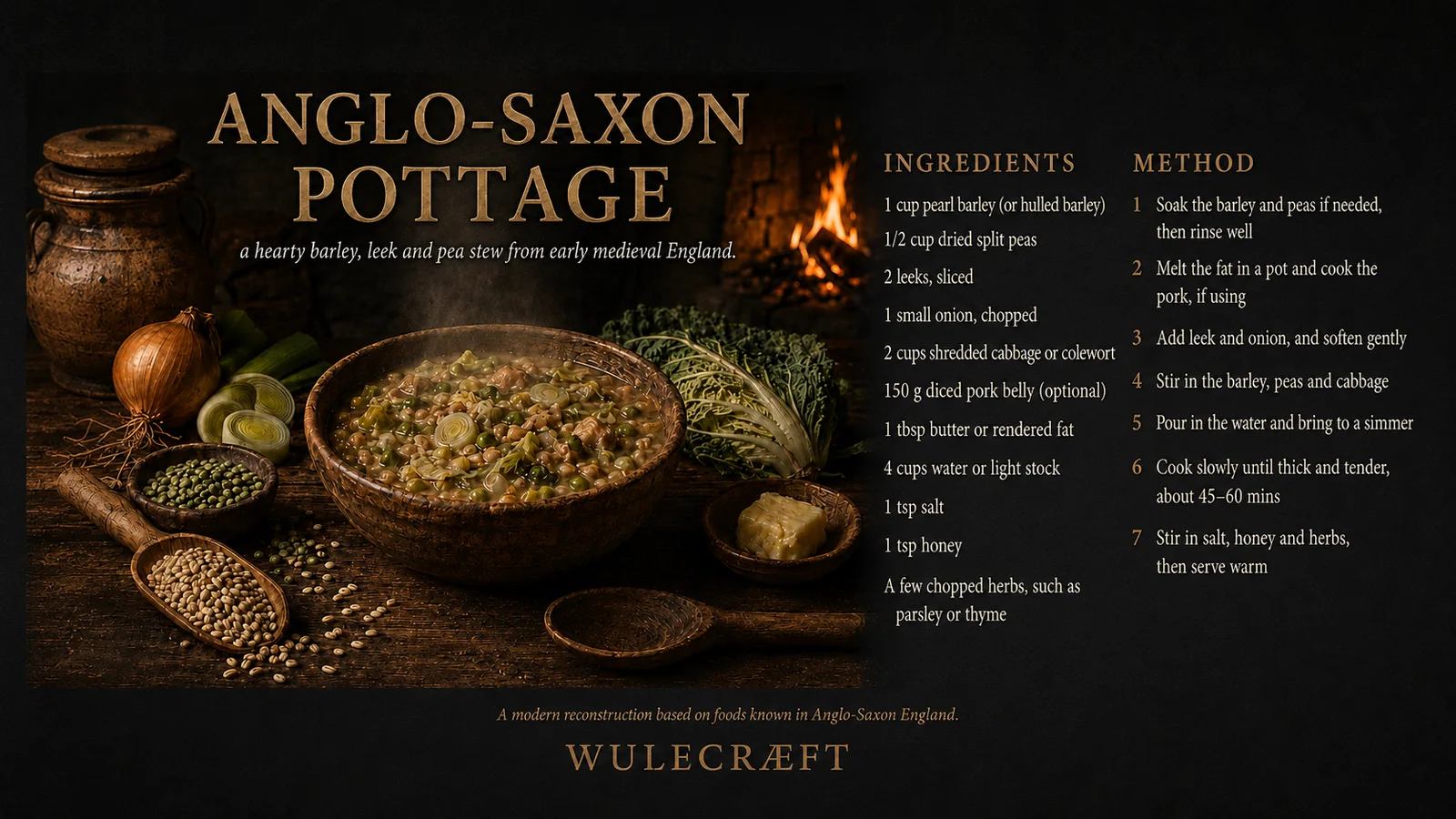
Barley Pottage with Roast Pork Belly
A pearl barley pottage built on leeks, onion, cabbage, and peas, with a little honey in the old manner — finished with a modern flourish of slow-roasted pork belly instead of simmered pork.
Ingredients
- 800g pork belly, skin scored
- 200g pearl barley*
- 2 leeks, sliced
- 1 onion, diced
- ½ cabbage, shredded
- 150g peas
- 1 tbsp honey
- 1.2L stock
- 2 tsp sea salt
- 2 tbsp olive oil or lard
Method
- Score the pork belly skin, rub with salt, and rest uncovered in the fridge (1 hour or overnight).
- Roast at 160°C for 2 hours, then 220°C for 20–25 minutes to crisp the skin.
- Soften the leeks and onion slowly in oil or lard until sweet, not coloured.
- Add the barley and stock. Simmer, partly covered, until tender with bite.
- Stir in the cabbage until wilted, then the peas, just to heat through.
- Off the heat, stir through the honey sparingly, to taste.
- Rest the pork 10 minutes, then carve and lay over the pottage.
The Scholar’s Note *Pearl barley is a modern substitute for the hulled barley (bere) of the period. Honey’s role here is deliberately restrained: Debby Banham (Food and Drink in Anglo-Saxon England, Tempus, 2004) finds little evidence it was used to sweeten cooking, suggesting it more likely sat on the table like salt. The slow-roasted pork belly is the one clear modern departure — Anglo-Saxon cooks generally boiled or stewed meat, reserving roasting for luxury occasions.
Why This Matters
Historical cooking is about more than recipes.
Every recreated meal is a reminder that the people who lived a thousand years ago worried about harvests, celebrated feast days, and gathered together over shared food much as we do now, and that, contrary to how we usually picture it, a noble’s table and a commoner’s table had more in common than not.
The ingredients were simpler. The cookware was different. But the instinct to feed the people you care about hasn’t changed. That’s perhaps why these old dishes still resonate; history isn’t only something we read. Sometimes it’s something we can taste.
Would you try pork belly over historical barley pottage?
Coming next: how honey shaped Anglo-Saxon cooking — from preservation to sweetening feasts — and a simple, historically grounded dessert to go with it.
Explore more food, cooking and hospitality in The Anglo-Saxon Table.
Sources
[1] Leggett, S. & Lambert, T., ‘Food and Power in Early Medieval England: a Lack of (Isotopic) Enrichment’ and ‘Rethinking Feorm’, Anglo-Saxon England (Cambridge University Press, 2022); University of Cambridge, ‘Anglo-Saxon kings were mostly veggie but peasants treated them to huge BBQs’, cam.ac.uk, April 2022.
[2] History Hit, ‘What Did the Anglo-Saxons Eat and Drink?’, historyhit.com.
[3] History Hit, ‘What Did the Anglo-Saxons Eat and Drink?’, historyhit.com; Regia Anglorum, ‘Food and Drink in Anglo-Saxon England’, regia.org; English Heritage, ‘What to Grow in a Medieval Herb Garden’, english-heritage.org.uk.
[4] Tastes of History, ‘Anglo-Saxon Fare Fit for a Battle’, tastesofhistory.co.uk; Banham, D., ‘The Earliest English Culinary Recipes: Dietary Advice in Old English Medical Texts’, Journal of Medieval History (2023).
Read next
Daily Life in Anglo-Saxon England: Food and WorkOne bad spell of weather could undo months of effort. Seed might fail, fodder could run short, and an animal lost to illness represented more than a missed meal. Cattle could provide traction, milk, hides and meat; sheep supplied wool as well as food; pigs could forage in woodland. Their value ran through the whole household economy.
Be the first to leave a thought on this essay.
Comments are held for review before they appear.