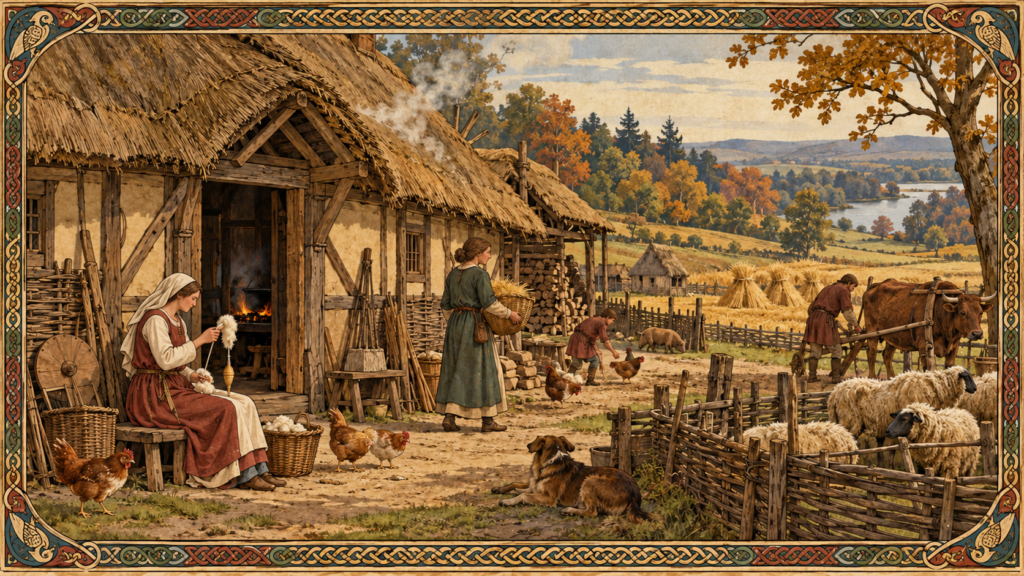
Food, fire, clothing and the work that carried a household through the year
A day in your life in Anglo-Saxon England might look like this:
You come in from a wet field on an autumn evening. Your shoes are muddy, your wool cloak is heavy with rain, and the fire has to be fed before anyone can eat. The days are getting shorter and the air is starting to bite. There is grain to grind, livestock to check and a store of food that has to last through winter.
That scene is an informed reconstruction, not a day recorded in someone’s diary. But it gives us a better place to start than the usual picture of kings, swords and feasting halls. Most people spent far more time growing food, tending animals, making cloth and keeping a household going.
Nor was there one fixed “Anglo-Saxon way of life.” Between the fifth and eleventh centuries, people lived in different regions, settlements and circumstances. A family on a farm did not experience the same day as a monk, a craftworker in a trading town or a member of a royal household. Much of what follows describes rural life, where farming shaped the year. Archaeology and written evidence help us recover its outlines, though no source can give us every smell, sound or ordinary conversation (Hamerow 2012; Banham and Faith 2014).
The year decided what had to be done
Spring meant preparing the ground and sowing. Summer brought haymaking, care of livestock and the long wait for crops to ripen. Autumn was harvest time: food had to be gathered and stored, animals managed, and enough fuel made ready for the colder months. Winter did not bring the work to a halt. It changed where and how it was done.
One bad spell of weather could undo months of effort. Seed might fail, fodder could run short, and an animal lost to illness represented more than a missed meal. Cattle could provide traction, milk, hides and meat; sheep supplied wool as well as food; pigs could forage in woodland. Their value ran through the whole household economy (Banham and Faith 2014).
You would have heard the work all around you: animals calling from the yard, timber being split, grain being ground and voices carrying over the wind. Each season brought its own demands, and people planned their days around the work that could not wait.
What did people eat?
The everyday meal was more likely to begin with grain than a joint of meat. Wheat, barley, rye and oats could be made into bread, ale or boiled dishes. Peas, beans and other vegetables added variety, while eggs, dairy, fish and meat depended on what a household had access to and when (Banham and Faith 2014).
Old English brīw referred to a boiled, porridge-like food. It does not give us one precise recipe to recreate. Think instead of a practical meal made from available ingredients, cooked in a pot near the fire.
Ale mattered in the household and at gatherings. But the familiar claim that everyone drank ale because water was always unsafe goes further than the evidence allows. Water was also drunk; its quality depended on the source and its handling.
And what of the richly laden feast? It was real, but it should not stand in for breakfast on an ordinary Tuesday. Research into chemical traces preserved in human bones found that sustained diets high in animal protein were rare before Scandinavian settlement. People buried with signs of high status did not consistently show a meat-heavy diet. Written evidence for feasts still matters: powerful households could draw on food supplies and feed many guests. The point is that an exceptional meal tells us something different from a daily one (Leggett and Lambert 2022; Lambert and Leggett 2022).
A house needed constant attention
Many rural buildings were constructed mainly from timber and other perishable materials. As a result, archaeologists often find not the buildings themselves but the marks they left in the ground: postholes, trenches, pits and, sometimes, hearths. These traces can reveal a building’s size and layout, but they cannot show us exactly how every room once looked (Hamerow 2012). Excavated settlements such as West Halton demonstrate that buildings and farm spaces could also change over the course of centuries.
The hearth provided heat, light and a place to cook, but it also required a steady supply of fuel. Wet clothing had to be dried; food, tools and bedding had to be protected from damp; and roofs and walls needed regular repair. Beyond the reach of the fire, an evening interior could become dark very quickly.
We can reasonably imagine the smell of smoke, wet wool and cooking grain. We should be more cautious, however, about claiming that every house smelled the same or that every family slept beside its cattle. A settlement’s buildings, animals and working areas were closely connected, but their arrangement varied from place to place.
Storage mattered just as much as shelter. Grain saved after the harvest, a sound vessel, repaired tools and a supply of fuel all represented work already completed. Together, they gave a household greater security and bought its members time when the weather turned
The work inside a wool cloak
A cloak was never just a piece of cloth bought ready to wear. Someone had to tend the sheep, collect and prepare the fleece, spin the fibre, weave it and make the garment. Later came mending and reuse. Linen took its own labour to grow and prepare (Owen-Crocker 2004).
Textile work was often associated with women, but a single rule cannot describe every household across six centuries. Archaeological finds such as spindle whorls and loom weights show how important spinning and weaving were to domestic production. The work took skill and time, and a garment carried both.
The clothing was not all dull brown, either. Fibres could be dyed, and the quality of cloth differed. Brooches and pins fastened garments while also displaying wealth or fashion. A surviving brooch tells us something about dress; it cannot tell us that everyone dressed like the person who owned it. The British Museum’s Anglo-Saxon collections make that difference especially clear when richly made objects are set beside the broader evidence for everyday work.
Can we really know what it felt like?
Only in part. Bone, grain, tools, buildings and written records survive unevenly. A law code tells us what someone tried to regulate, not necessarily what happened in every home. A poem’s hall is powerful evidence for what its audience could imagine and value, but it is no complete record of ordinary meals.
Still, the evidence lets us get close enough to ask better questions. Who gathered the fuel for that fire? How long did it take to turn fleece into a warm garment? What happened when the harvest came in short? Those questions bring more people into the story than kings and battles alone.
Modern life often hides the labour behind food, clothing, heat and light. In an Anglo-Saxon household, much of that labour stayed in view. A meal began in a field; a cloak began with an animal; warmth began with fuel collected and carried by hand. This was not a simpler or more romantic life. It was a life in which the next season was already present in the work of today.
The scholar’s note: did elites eat more meat?
Large feasts and everyday diet answer different questions. The isotope study by Sam Leggett and Tom Lambert found no consistent link between rich grave goods and a sustained diet high in animal protein in its early medieval sample. Their companion study of food renders explains how powerful households could nevertheless assemble substantial feasts. Neither result means rank had no effect on access to food. It means we should be careful about turning a feast scene into a week’s menu (Leggett and Lambert 2022; Lambert and Leggett 2022).
Next:
Compare an Anglo-Saxon peasant’s diet with your own in the Anglo-Saxon Life Starter Kit. What’s similar? What surprised you?
Learn how to make your very own Pottage
Further reading
- Banham, Debby, and Rosamond Faith. Anglo-Saxon Farms and Farming. Oxford: Oxford University Press, 2014.
- Hamerow, Helena. Rural Settlements and Society in Anglo-Saxon England. Oxford: Oxford University Press, 2012.
- Lambert, Tom, and Sam Leggett. “Food and Power in Early Medieval England: Rethinking Feorm.” Anglo-Saxon England 49 (published online 2022).
- Leggett, Sam, and Tom Lambert. “Food and Power in Early Medieval England: a Lack of (Isotopic) Enrichment.” Anglo-Saxon England 49 (published online 2022): 155–196. Read the article.
- Owen-Crocker, Gale R. Dress in Anglo-Saxon England. Revised edition. Woodbridge: Boydell, 2004.
Read next
Women’s Rights in The Age of BeowulfQueens, landowners, household managers and abbesses exercised different forms of authority. Poetry, wills and archaeology reveal the possibilities—and limits—of women’s power in Anglo-Saxon England.
Be the first to leave a thought on this essay.
Comments are held for review before they appear.