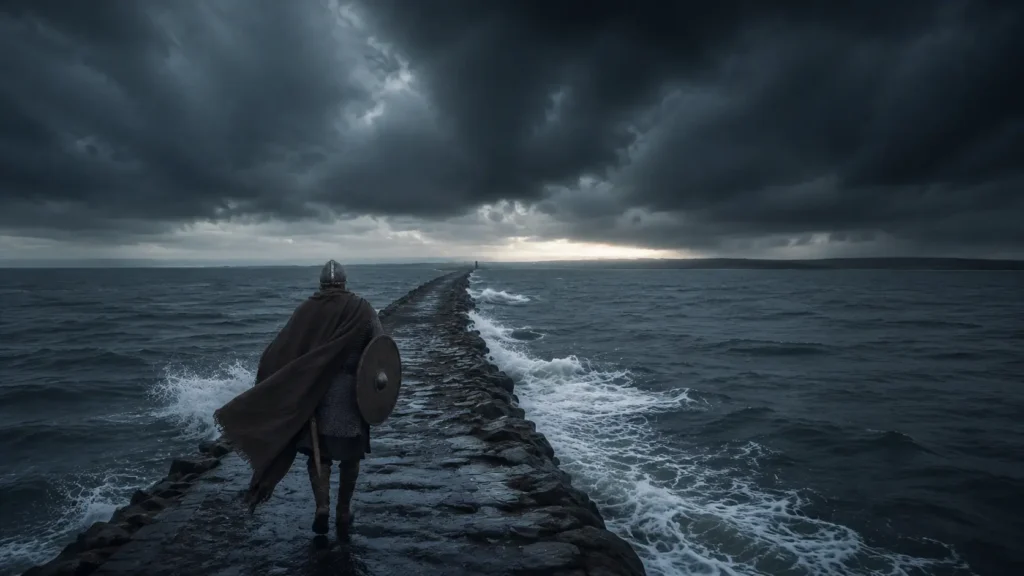
From Beowulf to a language buried within our own to swords still surfacing in Kentish soil, the early medieval world keeps finding new readers.
Historical Context
Hwæt! Wē Gār-Dena in geārdagum… So opens Beowulf, arguably the best-known poem to survive from Anglo-Saxon England. “Listen! We have heard of the glory of the Spear-Danes’ kings in days gone by” (trans. Wulfcræft). Only one damaged manuscript preserves it: the Nowell Codex, which escaped a 1731 fire that destroyed part of the Cotton library. The Wanderer, The Seafarer and The Ruin fared little better. All three survive only in the Exeter Book, a single manuscript that a scribe copied in the late tenth century. Bishop Leofric later gave it to Exeter Cathedral in 1072 (Krapp and Dobbie 1936). In short, a handful of manuscripts carry almost everything we know of Old English poetry, and each one survived fire, damp, and four centuries of Reformation-era dispersal more or less by chance.
That narrow evidence base matters. It is why archaeology now carries as much weight as philology in reconstructing the period, and why a single new find can shift the picture more than a new poem could.
Four Reasons Why The Anglo-Saxon Period Captures Our Imagination
A language still inside our own
For many people, Old English first looks almost completely foreign on the page. But set the unfamiliar spelling aside, and recognizable words start to emerge. Hūs becomes “house.” Stān becomes “stone.” Winter remains almost exactly what it was a thousand years ago. Old English is not sealed behind glass; it forms part of the deep structure of the language millions of people still speak today.
Poetry that needs no translation
The poetry rewards that same patience. In The Wanderer, the speaker has lost his lord, his companions and his place in the world. In The Seafarer, a solitary figure endures cold, isolation and the sea’s relentless movement. The Ruin contemplates buildings — probably the Roman remains at Bath — that once seemed permanent and now stand broken (Klinck 1992). None of this asks readers to share the social world of an Anglo-Saxon exile. Grief, loneliness and uncertainty need no translation.
What the ground keeps giving back
Archaeology supplies the other half of the picture, and the last two years have been unusually active. In 2024, a Time Team excavation at Sutton Hoo’s Garden Field recovered the long-missing base of the Bromeswell Bucket, a sixth-century vessel likely made in Antioch, in the eastern Mediterranean. Analysis at the University of Bradford found cremated human and animal remains inside it. As a result, researchers now know that Anglo-Saxons eventually reused the bucket as a cremation container in Suffolk, a full century or more after it was made (medievalists.net 2025).
Meanwhile, an as-yet-undisclosed Anglo-Saxon cemetery in Kent yielded a sixth-century sword of exceptional preservation in December 2024. It has a silver-and-gilt hilt, a runic inscription on the blade, and surviving fragments of a beaver-fur-lined scabbard. Lead archaeologist Duncan Sayer ranked it alongside the sword from the Sutton Hoo ship burial itself. Grave goods from the same cemetery point the same way: Scandinavian objects turned up in an earlier burial, Frankish items in a later one, suggesting a community with active continental contacts throughout (The Guardian 2024).
Beyond swords and kings
Even so, curiosity is not confined to weapons and royal burials. A comb, a brooch, a gaming piece or a handwritten line in a damaged manuscript can bring an individual life closer than any sword can.
Why It Still Matters
None of this makes early medieval England less distant. Its halls have returned to the earth. Its ships survive only in memory, and time has swallowed most of its literature. Even so, enough remains — by luck as much as design — for something to cross the centuries. It may be that readers return to this material not because their circumstances resemble those of a sixth-century exile, but because the emotional terrain the poems describe has proved more durable than the halls themselves: loss, displacement, and the plain awareness that nothing built by hand lasts.
Scholar’s Note
The Bromeswell Bucket poses a genuine, unresolved problem rather than a settled story. Byzantine craftspeople made the vessel in the eastern Mediterranean roughly a century before an East Anglian community buried it in Suffolk. In that time, it likely passed through several hands, and possibly several purposes, before ending up as a container for cremated remains. So how did it arrive: as diplomatic gift, trade good, or heirloom? And what did its Byzantine imagery mean to the Anglo-Saxons who eventually used it?
Do you agree with medievalists.net that the 2024–25 excavation has sharpened these questions rather than settled them? Let us know in the comments.
Further Reading
Krapp, George Philip, and Elliott Van Kirk Dobbie, eds. 1936. The Exeter Book. Anglo-Saxon Poetic Records, vol. 3. New York: Columbia University Press.
Fulk, R. D., and Christopher M. Cain. 2003. A History of Old English Literature. Malden, MA: Blackwell.
Medievalists.net. 2025. “Medieval Mystery Solved: Sutton Hoo Bucket Was a Cremation Vessel.” 3 June. medievalists.net.
The Guardian. 2024. “‘Really Incredible’ Sixth-Century Sword Found in Kent.” 26 December.
Note on sourcing: the Guardian and Medievalists.net pieces are cited by publication rather than by named journalist, as no individual byline could be confirmed from the available reporting. If you have access to the original bylines, they should be added before this goes to print.
Read next
The Battle of Maldon: Courage, Pride and the Will to EndureExplore The Battle of Maldon, Byrhtnoth's ofermod and Byrhtwold's famous speech in this guide to courage, pride and Anglo-Saxon loyalty.
Be the first to leave a thought on this essay.
Comments are held for review before they appear.