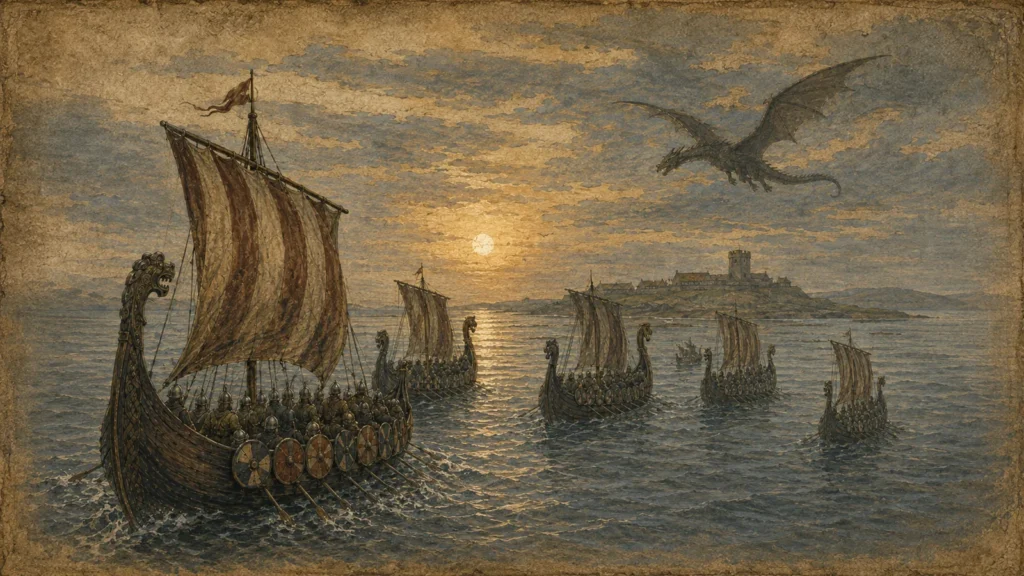
Historical Context
Most scholars and historians agree the plundering of Lindisfarne occurred in June, 793 AD. It is widely accepted that The Irish monk Aidan founded Lindisfarne in 634, at the invitation of the Northumbrian king Oswald. From all accounts, the monastery grew into one of the great centres of English Christianity. Cuthbert, bishop of Lindisfarne in the 680s, became its most venerated figure. His shrine drew pilgrims, and his cult drew wealth — gold, silver, and manuscripts, among them the Lindisfarne Gospels.
On 8 June 793, raiders from Scandinavia landed on this tidal island off the Northumbrian coast and sacked the monastery. The Anglo-Saxon Chronicle records the event. Two contemporary letters from the Northumbrian scholar Alcuin of York describe it at length; Alcuin was living at the court of Charlemagne when the news reached him. A later account survives in the Historia Regum, which twelfth-century writers compiled and traditionally credit to Symeon of Durham. Together, these sources give us something rare for this period: a near-immediate, multi-angled record of how the Anglo-Saxon world made sense of its own catastrophe.
The shock of it reshaped Anglo-Saxon England though
The Plundering of Lindisfarne was not the first Viking landfall in Britain. A smaller raiding party had already killed a royal reeve at Portland, on the Wessex coast, in 789 (Anglo-Saxon Chronicle, s.a. 789). But Lindisfarne struck at something larger than a coastal village. It struck at the spiritual heart of Northumbria, and the shock of it reshaped how Anglo-Saxon England understood its own safety.
What the Chronicle Says
The Anglo-Saxon Chronicle builds a sense of dread before it even describes the raid: omens in the sky, then famine, then the attack itself. In the widely circulated English rendering of the entry, fierce portents came over the land of the Northumbrians, and the people felt sore terror. Violent whirlwinds and flashes of lightning tore across the sky, and witnesses reported fiery dragons flying through the air. A great famine followed. Not long after, heathen men destroyed Godes cyrican — God’s church — on Lindisfarne, through plunder and slaughter (Anglo-Saxon Chronicle, s.a. 793).
The scribe does not record a robbery here. He records a desecration.
When It Actually Happened
The Chronicle dates the attack to January, but that date does not survive scrutiny. Winter crossings of the North Sea in an open longship were dangerous and impractical. As mentioned earlier, it is widely held that the Plundering of Lindisfarne occurred on 8 June 793 instead (Britannica, “Lindisfarne Raid”; English Heritage, “The Viking Raid on Lindisfarne”). Most read the January date as a scribal error rather than a rival tradition. A summer raid also fits the pattern of the attacks that followed at Jarrow and Iona within the next two years.
How Contemporaries Understood It
Alcuin heard the news from a distance and wrote back in anguish. In a letter to King Æthelred of Northumbria, he described the church of St Cuthbert as “spattered with the blood of the priests of God” and “despoiled of all its ornaments.” This place, he wrote, had once stood more venerable than any other in Britain; now it lay open as prey to a pagan people (Alcuin, letter to King Æthelred, 793).
N.B: this rendering is widely reproduced, but we have not yet traced the original translator to a specific scholarly edition.
The Historia Regum strikes a similar note. It describes the raiders as having “laid everything waste with grievous plundering,” trampling the holy places and carrying off the church’s treasures (Historia Regum, attributed to Symeon of Durham).
Alcuin did not stop at description. He asked what the plundering of Lindisfarne meant, and framed it as a possible judgment on the sins of the Northumbrian people — a common way for an early medieval Christian writer to make sense of catastrophe. English Heritage’s account of the raid notes a striking detail: six weeks before the attack, mourners had buried the Northumbrian nobleman Sicga at Lindisfarne itself. Sicga had a hand in the 788 killing of King Ælfwald, and he died by his own hand in February 793 (English Heritage, “The Viking Raid on Lindisfarne”). This may be the “great guilt” Alcuin had in mind. Whether or not that connection holds, Alcuin’s letters make one thing clear: many contemporaries read the raid as more than violence. They read it as a verdict.
After the Raid
The monastery did not end in 793. The community at Lindisfarne carried on, and Cuthbert’s cult remained one of the most powerful in the north of England for centuries afterward. Eventually, further Viking pressure forced the monks to carry the saint’s relics inland — first to Norham, then to Chester-le-Street, and by 995 to Durham.
The raid was a wound, not an ending. What changed permanently was the assumption behind it: that a monastery, however holy, stood safe simply because it was holy. After 793, no one in Northumbria believed that again.
Why It Still Matters
We usually remember the Plundering of Lindisfarne as the opening scene of the Viking Age, and that framing is fair. It was the raid that reached Charlemagne’s court and entered the letters of the most connected scholar in Latin Christendom. But its deeper significance lies in what it reveals about the Anglo-Saxon world’s own sense of order — a cosmos in which sacred space was supposed to be protected space. The raiders did not just take silver and captives. They dismantled that assumption, and English Christendom spent the next two and a half centuries learning to live without it.
Scholar’s Note
Who were the Lindisfarne raiders, exactly? Early sources call them “heathen men” or “northmen” — broad terms that do not identify a specific origin, and historians still debate the question. Some favour western Norway. They point to Alcuin’s own description of the raid: he wrote that never before had such terror appeared in Britain, “nor was it thought that such an inroad from the sea could be made” (Alcuin, letter to King Æthelred, 793). This language reads more naturally as describing a long, unfamiliar crossing than the shorter routes Danish raiders already used further south. Others urge caution, arguing the sources are too thin to fix a precise homeland with confidence. This remains a live, unresolved question in the scholarship rather than a settled fact, and we should treat it that way instead of picking a side for narrative convenience.
Further Reading
- Anglo-Saxon Chronicle, s.a. 789, 793 — the primary account, in the standard editions.
- Alcuin of York, letters to King Æthelred of Northumbria and Bishop Higbald of Lindisfarne, 793 — the fullest contemporary reaction to the raid.
- English Heritage, “The Viking Raid on Lindisfarne,” english-heritage.org.uk — a reliable institutional overview, including the Sicga burial detail.
- Britannica, “Lindisfarne Raid,” britannica.com — for the consensus dating and general context.
About Wulfcræft
Wulfcræft is devoted to the poetry, manuscripts, and material culture of Anglo-Saxon England — read closely, sourced carefully, and set in the context that lets a modern reader understand them on their own terms.
Read next
Silver, Scales, and the Shape of TradeA chest of silver at Cuerdale reveals two ways to pay. Coins, bullion and merchants’ scales show how Scandinavian settlement reshaped trade in Anglo-Saxon England.
Be the first to leave a thought on this essay.
Comments are held for review before they appear.