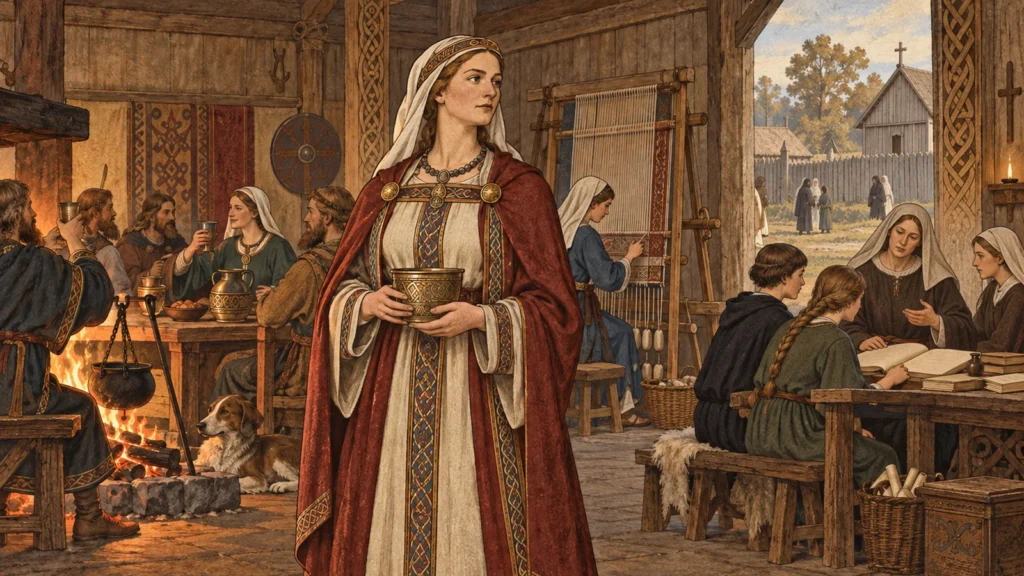
Power in Anglo-Saxon England did not always wear a crown or carry a sword. Women in Anglo-Saxon England could exercise authority through the measured words of a queen, the management of land and treasure, the labour of the loom or the governance of a religious community. This post looks at the rights of women in the age of “Beowulf ” (Anglo-Saxon England) and how this played out in everyday life.
Rank, Kinship & Circumstance
Power could pass through the measured words of a queen in the hall, the management of land and treasure, the labour of the loom or the authority of an abbess whose counsel was sought by kings.
Women did not stand outside the structures that governed Anglo-Saxon life. They worked within them. Rank, kinship and circumstance restricted what they could do, yet the surviving evidence reveals women shaping households, dynasties and religious communities.
Their power was rarely absolute…but it was real.
It could pass through the measured words of a queen in the hall, the management of land and treasure, the labour of the loom or the authority of an abbess whose counsel was sought by kings.
Women did not stand outside the structures that governed Anglo-Saxon life. They worked within them. The surviving evidence from the time reveals women shaping households, dynasties and religious communities.
Historical Context
Anglo-Saxon society rested upon households, lordship, kinship and the Church. Most kings, bishops and military leaders were men.
No honest account should turn early medieval England into a society of modern equality.
Yet authority did not belong only to those who held royal titles or bore weapons. Women could control property, manage households, carry dynastic alliances and govern religious communities.
Their influence appears unevenly across poetry, law, archaeology and ecclesiastical history. No single source gives us the complete picture. Poetry deals in ideals and anxieties. Laws reveal what society attempted to regulate. Grave goods reflect choices made by the living as well as the identities of the dead.
Read together, however, these sources reveal women acting within some of the central institutions of Anglo-Saxon life (Fell 1984; Klinck 1982).
The Queen in the Hall
In Beowulf, aristocratic women frequently appear inside the hall. They carry the ceremonial cup, speak before assembled warriors and participate in the rituals through which rank and loyalty become visible.
When Wealhtheow enters Heorot, the poet calls her cynna gemyndig: “mindful of customs” or “heedful of ceremonial courtesies.” He also describes her as goldhroden, “adorned with gold” (Beowulf, ll. 612–14).
The language presents a queen who is both richly displayed and socially attentive. As Wealhtheow moves through the hall, the order in which she offers the cup recognises the rank of those assembled. Her speeches then turn towards succession, loyalty and the future of the Danish court.
Wealhtheow does not possess Hrothgar’s authority. Nevertheless, she is far from silent. Her words attempt to shape how royal power will pass from one generation to the next.
Yet Beowulf places another powerful mother beyond the warmth and order of Heorot.
Grendel’s mother lives beneath the mere, in a hostile hall cut off from human society. She carries no ceremonial cup and speaks no public counsel. Instead, she acts through physical strength and vengeance. After Beowulf kills Grendel, she enters Heorot to avenge her son and recover his severed arm.
Her violence makes her an enemy of the Danes, but her motive would have been familiar to them. The heroic world expects a slain kinsman to be avenged or compensated. Grendel’s mother answers death with death, following the same logic of feud that governs the human societies above the mere.
The contrast with Wealhtheow is therefore more complicated than order against savagery. Both women act in defence of kin. Both attempt to preserve a threatened familial order. However, Wealhtheow works through ceremony, speech and recognised social position, while Grendel’s mother possesses no accepted place within the human hall. Her authority exists outside its laws, and the poem transforms that authority into something terrifying.
The hall, then, is not merely a masculine world of drinking, gift-giving and heroic boasts. It is a political space in which a queen may speak publicly, distribute honour and intervene in dynastic affairs. Beyond it waits another kind of female power: maternal, formidable and unwilling to leave the death of a son unanswered (Klein 2006).
The Burden of the Peace-Weaver
Old English poetry also connects noblewomen with peace made through marriage. The most familiar word for this idea is freoðuwebbe—“peace-weaver.”
The exact form appears only once in Beowulf, at line 1942, during the account of the violent Queen Modthryth. The compound joins freoðu, “peace,” with a form related to weaving. It creates the image of a woman expected to bind separate families or peoples together.
However, freoðuwebbe was not a formal occupation. Nor does its appearance prove that every aristocratic woman who entered a dynastic marriage carried the title “peace-weaver.”
Instead, the word expresses an expectation.
A woman might stand between two rival peoples and embody the promise of peace. She could bear children who united two lines, carry customs from one court into another and create new bonds of kinship. Yet she could not always control the men whose grievances and ambitions threatened that settlement.
For that reason, the image of weaving is both honourable and troubling. It recognises the diplomatic importance of the woman while placing responsibility for peace upon someone who may have possessed little power to prevent renewed violence.
The poem itself refuses to make the ideal comfortable. Again and again, marriages fail to end feud. The threads hold for a time, and then men cut through them (Cavell 2015).
The Loom and the Household
Beyond the royal hall, women could exercise authority through the management of the household.
Textile production demanded skill, patience and sustained labour. Workers first cleaned and prepared the wool. They then spun the fibres into thread and wove that thread into cloth. The finished material supplied clothing, bedding and goods suitable for exchange.
The loom did not belong to a merely decorative female world. It stood near the heart of the household economy (Owen-Crocker 2004).
Keys discovered in some female graves may offer another glimpse of household responsibility. Archaeologists have often interpreted them as signs of access, status or control over stored goods. However, this evidence requires care.
A key buried with a woman does not prove that she held a recognised office. Grave goods could carry symbolic meanings chosen by the mourners who arranged the burial. Even so, keys and related objects occur predominantly in female burial contexts, although scholars continue to debate their precise significance.
The modern label “keyholder” is therefore useful only when qualified. Control over food, cloth, tools and stored wealth could place household management close to the workings of hospitality and survival.
Archaeology gives us the object, however, not a written job description.
Property, Wealth and Wynflæd’s Will
Written records provide firmer evidence that some Anglo-Saxon women owned and transferred property.
The surviving will of Wynflæd records the distribution of estates, clothing, jewellery, vessels, livestock and religious gifts. The document opens a narrow but revealing window into the life of a wealthy tenth-century woman.
Wynflæd appears not as a passive recipient of property but as a landowner deciding how her wealth should pass to others. Her possessions connected family, household and religious obligation. Estates went in one direction; clothing, precious objects and livestock in another.
Her will does not prove that all women enjoyed equal property rights. Rank mattered enormously, as did family position and local circumstance. Nevertheless, the document shows a woman exercising considerable control over wealth and inheritance (Whitelock 1930; Sawyer S 1539).
Here female authority becomes difficult to dismiss. It survives not as a poetic image or an archaeological interpretation, but as a series of deliberate instructions concerning land, people and possessions.
Women Who Governed the Church
Some of the most public examples of female authority appear in the early English Church.
Hild governed the monastery at Streanaeshalch, later known as Whitby. Men and women lived under her authority, while Bede remembered her as a teacher and administrator whose counsel was sought by rulers and other leading figures.
Her community also hosted the Synod of Whitby in 664. There, King Oswiu and prominent churchmen debated competing approaches to Christian practice, including the calculation of Easter.
Hild did not preside over the theological dispute. Yet the gathering took place within the religious community she governed. That fact alone reveals the political and ecclesiastical importance of her house (Bede, Ecclesiastical History, III.25; IV.23).
An abbess of Hild’s standing directed land, personnel, education and religious observance. Her authority was exceptional, but it was not unique. Several major early English religious houses were governed by women from royal or aristocratic families.
These monasteries were not retreats from society. They held land, educated members of the elite and preserved political relationships, sacred traditions and family memory. Within them, women could command institutions that reached far beyond the walls of the religious community (Yorke 2003).
Status Written in the Grave
Archaeology adds another layer to the evidence.
Some richly furnished female burials from the seventh century contain jewellery, dress fittings, crosses and other religious objects. Such finds cannot tell us exactly what each woman did during her life. They do, however, reveal how certain women were remembered.
Burial was a public act. The mourners selected the objects, arranged the body and created an image of the dead for those who gathered at the grave.
Costly dress fittings or Christian symbols may therefore speak of status, family identity, religious affiliation or sacral authority. They do not provide a biography, but neither are they silent. They show that some women occupied positions important enough to demand elaborate and meaningful commemoration (Hamerow 2016).
Power Within Its Limits
The surviving evidence shows that women in Anglo-Saxon England exercised authority through several overlapping structures.
A woman might speak in the hall, preserve wealth through textile production, administer property, carry an alliance between families or govern a substantial religious estate.
Her influence depended heavily upon rank, kinship and circumstance as noted previously here. A queen possessed opportunities denied to an enslaved woman. A royal abbess could command lands and communities that remained far beyond the reach of most people, male or female.
Therefore, we should neither exaggerate female freedom nor mistake restriction for complete powerlessness.
Anglo-Saxon women worked within systems that men largely dominated. Yet some of those women learned how to use rank, property, ritual, kinship and religion to shape the world around them.
Why It Still Matters
Women in Anglo-Saxon England disappear from view when we measure power only through kings, battles and weapons.
Look instead at cynna gemyndig—the queen “mindful of customs”—and at the burden carried by the freoðuwebbe, the “peace-weaver.”
Look at the loom, the key, the written will and the monastery, and we start to see a broader landscape: women were not standing beyond the recognised structures of Anglo-Saxon authority… they were working within them, negotiating their limits and, at times, directing institutions upon which households and kingdoms depended.
I think it’s safe to say the sword leaves the deepest mark in heroic poetry. But as this post makes clear, it was not the only instrument by which the Anglo-Saxon world was held together.
The Scholar’s Note: Was “Peace-Weaver” an Anglo-Saxon Title?
“Peace-weaver” has become so familiar that modern writing sometimes treats it as a standard Anglo-Saxon title.
The surviving evidence is much narrower.
The exact form freoðuwebbe occurs only once in Beowulf, while related compounds appear in a small number of poetic contexts. Scholars therefore disagree over how far the word should serve as a general description of aristocratic marriage.
It may express an ideal imposed upon certain women rather than identify an established social role.
Old English poetry also complicates that ideal. Dynastic marriages do not reliably end feuds, and the woman expected to unite two peoples may remain vulnerable to both.
The word matters not because it gives us a simple definition of female power, but because it exposes the hopes, burdens and contradictions surrounding it.
Next:
Explore the language behind OE poems in the FREE WULFCRÆFT Old English Glossary, including words that open new ways of reading early English literature.
Did Beowulf’s Boar-Crested Helmet’s Really Exist? This FREE illustrated field guide puts the Old English text beside two of the most important surviving Anglo-Saxon helmets: Benty Grange and Sutton Hoo.
Further Reading
Bede. The Ecclesiastical History of the English People. Translated by Bertram Colgrave and R. A. B. Mynors. Oxford: Clarendon Press, 1969.
Cavell, Megan. “Formulaic Friþuwebban: Reexamining Peace-Weaving in the Light of Old English Poetics.” The Journal of English and Germanic Philology 114, no. 3 (2015): 355–372.
Fell, Christine E. Women in Anglo-Saxon England. Oxford: Basil Blackwell, 1984.
Hamerow, Helena. “Furnished Female Burial in Seventh-Century England: Gender and Sacral Authority in the Conversion Period.” Early Medieval Europe 24, no. 4 (2016): 423–447.
Klein, Stacy S. Ruling Women: Queenship and Gender in Anglo-Saxon Literature. Notre Dame: University of Notre Dame Press, 2006.
Klinck, Anne L. “Anglo-Saxon Women and the Law.” Journal of Medieval History 8, no. 2 (1982): 107–121.
Owen-Crocker, Gale R. Dress in Anglo-Saxon England. Revised edition. Woodbridge: Boydell Press, 2004.
Whitelock, Dorothy, ed. Anglo-Saxon Wills. Cambridge: Cambridge University Press, 1930.
Yorke, Barbara. Nunneries and the Anglo-Saxon Royal Houses. London: Continuum, 2003.
Read next
Daily Life in Anglo-Saxon England: Food and WorkOne bad spell of weather could undo months of effort. Seed might fail, fodder could run short, and an animal lost to illness represented more than a missed meal. Cattle could provide traction, milk, hides and meat; sheep supplied wool as well as food; pigs could forage in woodland. Their value ran through the whole household economy.
Be the first to leave a thought on this essay.
Comments are held for review before they appear.