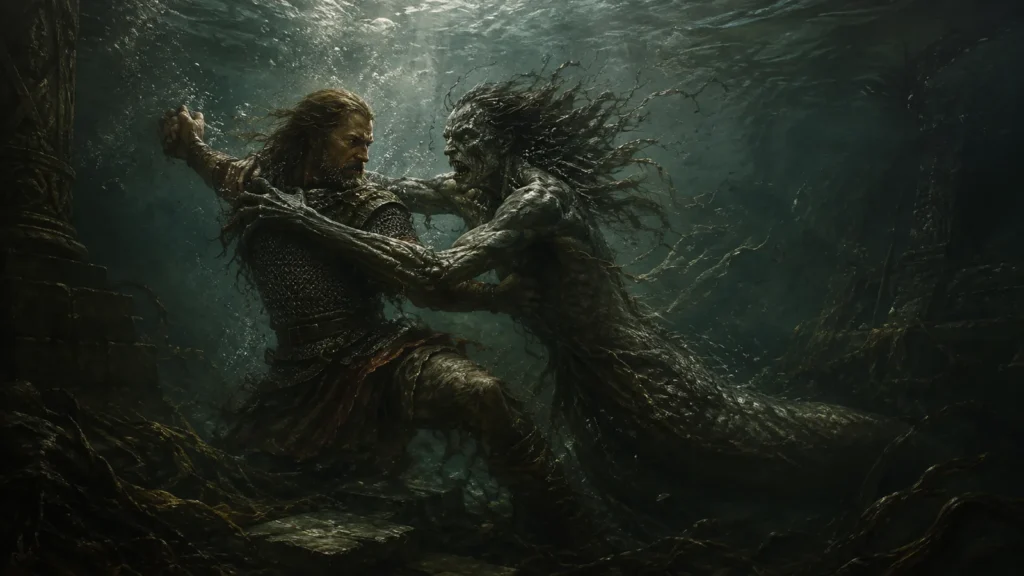
Beowulf fights Grendel’s mother because she attacks Heorot to avenge her son, killing Hrothgar’s trusted adviser, Æschere.
To protect the Danes and answer that killing, Beowulf follows her into the mere: a haunted body of water concealing her dwelling.
Yet this encounter carries more weight than another victory over a dangerous opponent. Beneath the surface, his trusted sword fails. Strength alone almost proves insufficient. The hero who restored hope to Heorot must now face a struggle beyond his companions’ reach.
For modern readers, that descent offers a powerful image of entering the unknown. However, its meaning begins with the poem’s own world: kinship, revenge, heroic duty and God’s power over human affairs.
The historical world behind the poem
An anonymous poet composed Beowulf in Old English, although scholars continue to debate when. Proposed dates range from the eighth century to around the time of its surviving manuscript.
The story itself takes place in Scandinavia, principally among the Danes and Geats. It looks back towards a distant heroic past through the perspective of a Christian poet.
Loyalty, courage and reputation shape this world. So do competing obligations: a warrior must defend his lord, honour his kin and respond to loss. Consequently, a victory can create the conditions for another act of violence.
The poem survives in one medieval manuscript, copied around AD 1000. Today, the British Library holds it as part of Cotton MS Vitellius A XV. Read about the Beowulf manuscript.
Grendel’s mother and the cycle of revenge
After Beowulf defeats Grendel, Heorot celebrates. Hrothgar rewards the hero, and the Danes enjoy relief from years of attacks.
Then Grendel’s mother comes.
She enters the hall as an avenger. Although the poet places her among humanity’s monstrous enemies, her motive follows a recognizable pattern: she has lost her son and seeks revenge.
Her attack therefore complicates the apparent certainty of Beowulf’s first victory. Grendel’s death ends one threat, but it also provokes another.
When she carries off Æschere, the loss strikes at Hrothgar’s household. Beowulf then agrees to pursue her. His descent answers both the danger she poses and the demand to avenge the king’s companion.
The episode exposes a troubling feature of the feud. Each side can understand its own violence as a response to an earlier wrong. Peace remains fragile because the dead leave obligations behind (Beowulf, lines 1251–1344, 1383–1396).
What does the mere represent?
Hrothgar describes a landscape of steep slopes, shadowed woods and dangerous water. At night, a strange fire appears upon the mere. Even a stag pursued by hounds would rather die on the bank than enter it (Beowulf, lines 1357–1376).
This detail makes the danger immediate. The hunted animal faces death on either side, yet the water presents the greater terror.
Within the poem, the mere separates the communal life of Heorot from a hostile realm beyond its protection. The hall offers fellowship, gifts and remembered deeds. By contrast, the depths conceal enemies whom the Danes cannot control.
We can therefore read the mere as a threshold between social order and the unknown. This is an interpretation of the poem’s landscape, rather than a fixed belief we can assign to every Anglo-Saxon listener.
Beowulf crosses that threshold willingly. The poet emphasizes his resolve, rather than explicitly describing him as afraid.
Nevertheless, readers can recognise the uncertainty of his position. He knows what he has promised to do. He cannot know exactly what awaits him below.
Wyrd and the limits of human control
Old English poetry often confronts the limits of human power through the word wyrd. Usually translated as “fate”, it can refer to what happens to a person or the course events take.
However, the word does not carry one simple philosophical meaning in every passage. In Beowulf, references to fate appear alongside the Christian narrator’s belief in God’s authority.
Earlier, Beowulf declares that fate often saves an undoomed man when his courage holds (Beowulf, lines 572–573). The statement brings courage and uncertain survival together. It does not promise that bravery always prevents death.
That tension also shapes the descent into the mere. Beowulf prepares carefully and acts decisively, yet neither preparation nor courage gives him complete control.
For a modern reader, this offers a point of connection. We can make thoughtful choices without knowing their outcome. Likewise, we can act with resolve while admitting that our resources have limits.
Why Hrunting fails against Grendel’s mother
Before the descent, Unferth lends Beowulf Hrunting, a sword with a distinguished history. Its reputation suggests that the hero carries a dependable weapon into danger.
However, Hrunting cannot wound Grendel’s mother. The blade that served others well proves useless in this encounter (Beowulf, lines 1457–1464, 1522–1528).
Beowulf casts it aside and grapples with her. She then gains the upper hand and attacks him with a knife. His mail-shirt protects him, while the narrator explicitly credits God with determining the victory (Beowulf, lines 1537–1556).
Only after this reversal does Beowulf see a giant-made sword among the weapons in the dwelling. He seizes it and kills his opponent (Beowulf, lines 1557–1569).
The sequence gives us more than an example of perseverance. Equipment, extraordinary strength and divine help all contribute to his survival.
Nevertheless, Hrunting’s failure remains a striking moment. A trusted weapon reaches its limit. Beowulf must respond to the danger before him, even though his original means of overcoming it has failed.
You can follow the encounter in J. Lesslie Hall’s public-domain translation of Beowulf.
Reading the descent through our own experience
The poem does not present this battle as a lesson in modern self-development. Its concerns include vengeance, reputation and divine power.
Even so, the scene invites reflection.
Fear sometimes returns through something we thought we had already overcome. A conversation reopens an old wound. Grief unsettles a familiar day. Meanwhile, an abandoned ambition reminds us of a disappointment we have never quite faced.
These experiences are not equivalents of Beowulf’s battle. However, the image of the mere can help us describe their uncertainty.
Perhaps your own “mere” is work you stopped after a failure. It might be a difficult conversation or a hope you no longer mention.
The connection lies in reaching a point where familiar answers no longer suffice. Like Hrunting, an approach that once helped may fail in a new situation.
At that point, perseverance may mean changing direction. It can also mean seeking help, learning another skill or accepting that progress will take time.
Beowulf enters the water without a companion beside him. Our own difficulties need not demand the same solitude.
Why the return from the mere still matters
After defeating Grendel’s mother, Beowulf finds Grendel’s body and cuts off his head. The giant sword’s blade then melts, leaving its hilt behind.
Eventually, he returns to the surface carrying the head and the hilt. His Geatish companions, who have continued to wait for him, welcome him back (Beowulf, lines 1584–1650).
That return matters as much as the descent. The episode carries him away from human fellowship, then brings him back into it.
For modern readers, this offers a quieter way to understand the encounter. Facing uncertainty does not have to end in isolation. What we learn through difficulty may help us return to the people and responsibilities that give life meaning.
The order we hope to restore cannot always be rebuilt from the shore. Sometimes we must approach what remains unresolved, while accepting that courage alone cannot guarantee the outcome.
That is one reason the mere still speaks to us today. Across a thousand years, it gives shape to the distance between what we can prepare for and what we must discover.
Sometimes the hardest step comes before anyone can see the struggle: the moment we choose to enter the unknown.
Next steps:
Find out what really happened at The Battle of Maldon
Explore the language behind the poem in the FREE WULFCRÆFT Old English Glossary, including words that open new ways of reading early English literature.
Read next
The Battle of Maldon: Courage, Pride and the Will to EndureExplore The Battle of Maldon, Byrhtnoth's ofermod and Byrhtwold's famous speech in this guide to courage, pride and Anglo-Saxon loyalty.
Be the first to leave a thought on this essay.
Comments are held for review before they appear.