Christianity played a big role in the change of Anglo-Saxon England. It changed how kings justified their authority, how communities buried their dead and how people understood the world beyond this life. Old English poetry shows what happened when Christian writers inherited the stories and values of the heroic past.
But the old culture did not simply disappear.
Its warriors, exiles, monsters and ruined halls survived in Old English poetry. So did its language of loyalty, vengeance, fate and courage. Christian poets inherited these older traditions and used them to explore a new faith.
The result was not pagan literature with a few Christian lines added later. Nor was it Christian teaching wearing an unconvincing Germanic disguise.
Something more interesting happened.
Anglo-Saxon poets took the emotional world of the heroic past and made it speak to a Christian present.
The Old World Beneath the New
By the time most surviving Old English poetry was written down, England had been Christian for centuries. Monasteries produced the manuscripts, and Christian scribes preserved the poems (Godden and Lapidge 2013).
Even so, the literature continued to look back.
Its heroes lived in halls and served earthly lords. Their security depended upon family, reputation and the loyalty of armed companions. When those bonds failed, the individual faced exile, feud or death.
These concerns did not become meaningless after conversion. They remained part of Anglo-Saxon society, even as Christianity offered a different understanding of salvation and eternity.
The poets did not have to choose between the two traditions. Instead, they brought them together.
Christ could appear as a warrior. The Cross could behave like a loyal retainer. A pagan hero could receive God’s protection without knowing the Christian faith. Meanwhile, an exile grieving for his lost lord could learn to place his hope in a heavenly one.
The old shapes remained, but their meaning changed.
Christ as the Young Warrior
No poem shows this transformation more clearly than The Dream of the Rood.
The poem retells the Crucifixion from the perspective of the Cross ( rōd in Old English). Rather than appearing as an ordinary piece of timber, the Cross speaks, remembers and suffers.
Most importantly, Christ does not approach it as a helpless victim.
The poem calls him a geong hæleð: a “young hero” or “young warrior.” He strips himself for battle, embraces the Cross and climbs upon it willingly (The Dream of the Rood, ll. 33–41).
The Crucifixion remains a sacrifice, but the poet describes it through the language of heroic courage. Christ does not have the nails driven into him while offering no resistance. He actively mounts the place of execution to begin his victory over death.
In turn, the Cross behaves like a retainer facing battle beside its lord. It trembles when Christ embraces it, yet it refuses to bend or fall because it must remain loyal:
“I dared not bow to the earth
or fall to the ground.”
—The Dream of the Rood, ll. 42–43 (my translation)
This creates a painful contradiction. A loyal retainer should defend his lord. The Cross, however, must help carry out Christ’s death. It stands firm because obedience demands it, even though that obedience causes its lord to suffer.
An Anglo-Saxon audience would have recognised the code beneath the Christian story. A warrior stands beside his lord. He shares the danger, receives wounds and refuses to abandon his position.
The poet did not change the Crucifixion into a pagan story. Instead, heroic tradition gave the audience a familiar way to understand Christ’s courage and the Cross’s loyalty (Swanton 1996, pp. 73–75; Ó Carragáin 2005, pp. 140–54).
Christianity had not erased the language of the warrior hall. It had given that language a new lord.
Pagan Heroes Beneath a Christian Sky
Beowulf creates a more complicated meeting between the two worlds.
The poem takes place in pre-Christian Scandinavia. Its kings and warriors belong to a distant Germanic past, yet the poet tells their story through a Christian understanding of history.
That tension appears almost immediately.
After introducing Grendel, the poet traces his ancestry to Cain, the biblical murderer condemned for killing his brother Abel. From Cain descend monsters, giants and hostile creatures that oppose God (Beowulf, ll. 99–114).
Grendel may inhabit the dark landscape of Germanic legend, but the poet gives him a place within Christian history.
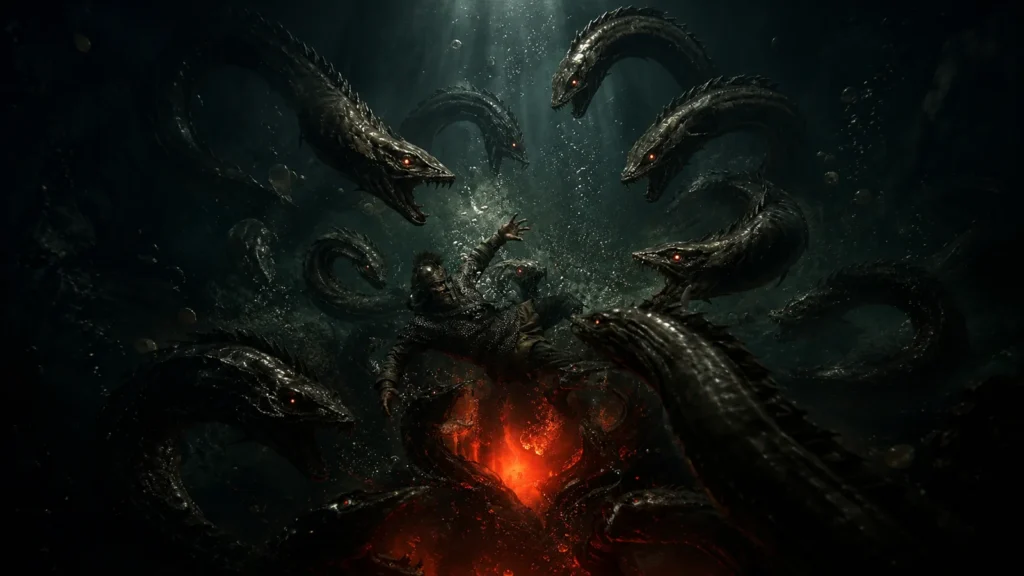
The connection becomes more striking when the poem turns to Grendel’s mother. She lives beyond the safety of the hall in a haunted mere filled with wolves, dark water and strange fire. However, she also belongs to the same cursed lineage. The monsters of the old northern landscape become descendants of a biblical exile.
Hrothgar’s Wisdom
The poet applies a Christian explanation to creatures that feel much older (Beowulf, ll. 1258–67; Orchard 2003, pp. 130–68).
Beowulf himself presents another difficulty. He is not a Christian, yet the narrator repeatedly describes God directing events around him. Divine favour protects him during his struggle with Grendel, guides him through the mere and allows him to find the giant sword that kills Grendel’s mother.
At the same time, the poem refuses to turn its pagan characters into Christians before their time.
When the Danes suffer under Grendel’s attacks, they visit pagan shrines and make offerings. The narrator responds with one of the poem’s clearest Christian judgements:
“They did not know the Judge of deeds.”
—Beowulf, l. 181 (my translation)
The poet understands something that the characters do not. They inhabit a heroic world filled with admirable courage and loyalty, but they remain separated from Christian revelation.
That does not make them worthless.
The poem respects Hrothgar’s wisdom, Wiglaf’s loyalty and Beowulf’s willingness to risk his life for others. Nevertheless, admiration sits beside sorrow. These men can achieve earthly glory, but the poet knows that the hall, the treasure and the body will eventually fall.
Beowulf does not preserve a pure pagan worldview. It looks back at pagan ancestors through Christian eyes and asks what remains valuable when their religious world can no longer be accepted (Robinson 1993, pp. 11–29; Orchard 2003, pp. 130–68).
Grendel’s Mother Between Two Traditions
Grendel’s mother deserves particular attention because she stands where several traditions meet.
On one level, she acts according to the logic of feud. Beowulf has killed her son, and she enters Heorot seeking repayment. Her attack mirrors the heroic obligation to avenge a slain relative, wergild in Old English parlance (Beowulf, ll. 1276–85).
However, the poem also places her outside the social structures that make vengeance legitimate. She does not speak before the hall or demand compensation. She enters at night, seizes Æschere and escapes to the mere.
Her grief is recognisable. Her methods make her monstrous.
The poet describes her through words that can suggest a female fighter, an avenger or a monstrous woman (Beowulf, ll. 1258–59). She therefore occupies an unstable position between human and non-human, mother and enemy, feud participant and biblical outcast.
Her mere deepens that uncertainty. It belongs to the dangerous landscape beyond the hall, where normal rules weaken. Yet the poet connects its inhabitants to Cain and the biblical history of rebellion against God.
Grendel’s mother is not simply a pagan monster converted into a Christian demon. She carries elements of feud culture, inherited legend and biblical interpretation at the same time.
That mixture is exactly what makes her so difficult, and so important.
She shows us a Christian poet working with older material that could not be fitted neatly into one category.
What Happened to Wyrd?
Few Old English words appear more closely tied to the pre-Christian past than wyrd.
It is often translated as “fate,” although that translation can be misleading. Depending on the context, wyrd may refer to what happens, the course of events or an outcome that has already unfolded.
Modern readers sometimes imagine it as an independent pagan force controlling human life. Old English poetry rarely makes the idea that simple.
In Beowulf, the hero declares:
Gæð ā wyrd swā hīo scel.
“Fate goes ever as it must.”
—Beowulf, l. 454b (my translation)
Elsewhere, however, Beowulf says that wyrd often saves an ‘undoomed’ man when his courage holds (Beowulf, ll. 572–73). Yet the poem also credits God with determining victory and controlling events (Beowulf, ll. 669–70, 1056–58).
Wyrd and divine providence can occupy the same poem because the word had not been trapped inside a single pagan meaning. Christian poets could use it to describe the unfolding of events without placing fate above God (Stanley 2000, pp. 85–109).
The old word survived. Its position in the universe changed.
The Wanderer’s Lost Lord
The Wanderer begins with a solitary man crossing the wintry sea after losing his lord, companions and place within society.
His suffering belongs to the heroic world. Without a lord, the wanderer has no protection, identity or community. He remembers placing his hands and head upon his lord’s knee as he made his pledge of loyalty.
Now that relationship survives only in memory.
The wanderer dreams that he embraces his lord again. Then he wakes to the dark waves and sees seabirds spreading their wings where familiar warriors once gathered. For a moment, the lost hall returns. Then the winter sea takes it away.
The poem eventually expands his personal loss into something larger. Walls collapse. Lords and warriors die. Treasure is stripped from the earth. The familiar ubi sunt passage asks:
“Where has the horse gone? Where is the rider?
Where is the giver of treasure?”
—The Wanderer, ll. 92–93 ( my translation)
Those questions belong to a world built around the hall. However, the poem does not restore that world. It shows why no earthly hall can provide permanent security.
The wanderer’s suffering leads him towards a Christian conclusion: stability can only be found with the “Father in heaven,” where lasting protection remains (The Wanderer, ll. 114–15).
His earthly lord has died. Therefore, the poem directs his loyalty towards a lord who cannot die.
The Christian ending does not cancel the exile’s grief. It depends upon it. The loss of the heroic world creates the emotional path towards Christian consolation (Klinck 1992, pp. 107–19).
The Seafarer Leaves the Hall Behind
The Seafarer begins with another isolated figure enduring cold, hunger and loneliness on the ocean.
He hears the cry of seabirds instead of laughter in the mead hall. Frost binds his feet. Hail strikes the earth. The comforts of life on land seem far away.
Unlike the wanderer, however, the seafarer feels drawn back to the water.
The sea is dangerous, but it also pulls him away from earthly security. Wealth, youth and political power will not last. No man can carry gold into death, and no treasure can protect the soul from God’s judgement (The Seafarer, ll. 97–102; Klinck 1992).
The heroic world remains present throughout the poem. It appears in the language of treasure, reputation, courage and loyalty. Yet the destination has changed.
The traditional warrior seeks glory through service to an earthly lord. The seafarer redirects that desire towards heaven. His journey becomes both physical and spiritual.
Once again, Christianity does not remove the older emotional structure. It changes where that structure leads.
Not Pagan Remnants Trapped in Christian Poems
It would be easy to describe these poems as Christian works containing fragments of pagan belief.
That explanation is too simple.
A Christian literary culture preserved the surviving poems. Their biblical references, theology and final movement towards God are not necessarily decorations added to otherwise pagan works.
Likewise, heroic language was not automatically pagan. Loyalty, courage, gift-giving, exile and vengeance remained part of Anglo-Saxon life after conversion. Christian writers could use that language without secretly worshipping the old gods.
The two traditions had also been in contact for generations. By the time these poems reached their surviving form, separating every “Christian” element from every “Germanic” one may already have been impossible.
The better question is not: “Which lines are pagan and which are Christian?”
It is: “What happens when a Christian poet inherits a heroic past?”
In The Dream of the Rood, Christ becomes the greatest warrior. Beowulf, pagan courage receives admiration but cannot escape death. In The Wanderer, the loss of an earthly lord creates a longing for a heavenly one, and in The Seafarer, the dangerous journey beyond the hall becomes a path towards eternity.
The old tradition survives in each poem, but it no longer stands alone.
A Literature Built From Tension
Christianity did not empty Anglo-Saxon England of its earlier stories, values and fears. It gave writers a new framework through which to understand them.
That process produced tension.
Heroic poetry celebrated earthly fame, while Christianity warned that worldly glory would pass. Feud culture demanded vengeance, while Christian teaching emphasised judgement and forgiveness. Warriors placed their faith in the lord of the hall, while the Church directed loyalty towards the Lord of heaven.
Old English poets did not always resolve those contradictions. Often, they used them.
That is why the literature still feels alive. Its characters stand between the world they know and truths they cannot fully see. Beowulf can defeat monsters but not death. The wanderer can remember his lord but cannot bring him back. The Cross can remain loyal to Christ only by taking part in his suffering.
Christianity changed the meaning of the stories without removing the older emotional world that gave them their power.
The old shapes remained visible beneath the new ones, and Old English poetry drew its power from the tension between them.
Explore related essays
Explore the language behind the poem in the FREE WULFCRÆFT Old English Glossary, including words that open new ways of reading early English literature.
Further Reading
Fulk, R. D., Robert E. Bjork and John D. Niles, eds. Klaeber’s Beowulf and the Fight at Finnsburg. 4th ed. Toronto: University of Toronto Press, 2008.
Godden, Malcolm and Michael Lapidge, eds. The Cambridge Companion to Old English Literature. 2nd ed. Cambridge: Cambridge University Press, 2013.
Klinck, Anne L. The Old English Elegies: A Critical Edition and Genre Study. Montreal and Kingston: McGill-Queen’s University Press, 1992.
North, Richard. Heathen Gods in Old English Literature. Cambridge: Cambridge University Press, 1997.
Ó Carragáin, Éamonn. Ritual and the Rood: Liturgical Images and the Old English Poems of the Dream of the Rood Tradition. London: British Library, 2005.
Orchard, Andy. A Critical Companion to Beowulf. Cambridge: D. S. Brewer, 2003.
Robinson, Fred C. The Tomb of Beowulf and Other Essays on Old English. Oxford: Blackwell, 1993.
Stanley, Eric Gerald. “Wyrd.” In Imagining the Anglo-Saxon Past: The Search for Anglo-Saxon Paganism and Anglo-Saxon Trial by Jury, 85–109. Cambridge: D. S. Brewer, 2000.
Swanton, Michael, ed. and trans. The Dream of the Rood. Rev. ed. Exeter: University of Exeter Press, 1996.
Read next
How Christianity Transformed Anglo-Saxon SocietyEngland’s kings could accept baptism in a day, but converting a culture took generations. The evidence reveals a slower and more complicated transformation.
Be the first to leave a thought on this essay.
Comments are held for review before they appear.