How Viking coins reshaped Anglo-Saxon England
Historical Context
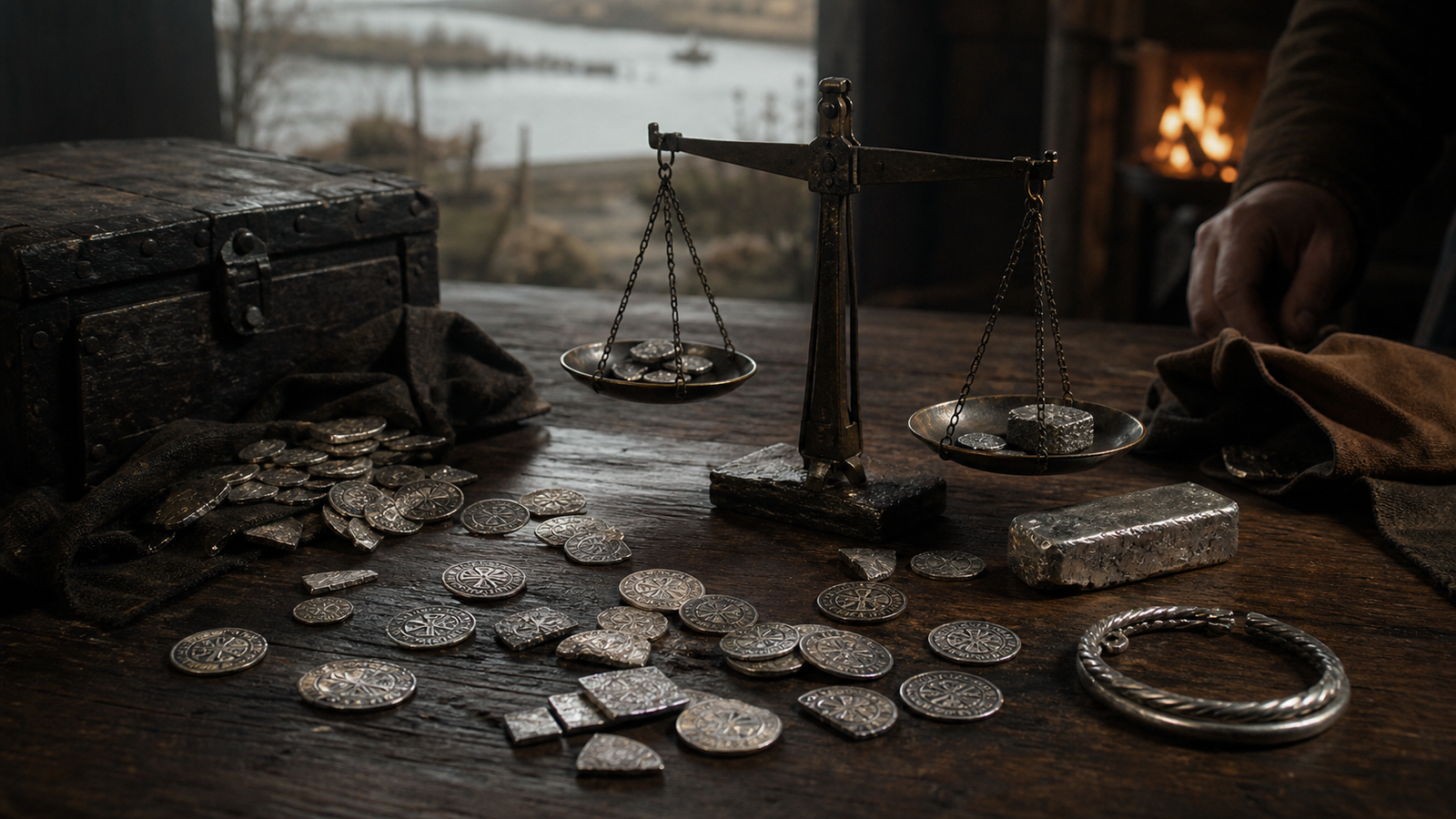
On 15 May 1840, workers repairing a flood-damaged embankment of the River Ribble at Cuerdale, near Preston, struck a lead chest buried in the mud. Inside lay roughly forty kilograms of silver: about 7,500 coins, plus well over a thousand pieces of bullion, ingots, and jewelry (Graham-Campbell 2011). Someone buried the hoard around AD 905 to 910, probably a person connected to the Scandinavian rulers of Dublin. They never returned for it, and the hoard remains the largest of its kind ever found in England.
Cuerdale matters not for its size but for its mixture. Anglo-Saxon pennies sit beside Viking arm-rings, Frankish coins, and Islamic Dirhams struck as far away as Baghdad. This single chest holds physical proof of a decades-long collision between two ways of handling money. That collision reshaped English trade long after the last Viking ship had gone home.
Two ways to pay
Anglo-Saxon England, like most of early medieval Europe, ran on coin. A silver penny was struck to a fixed weight under royal authority. Its value came from the king whose name it carried. Scandinavian settlers arriving after 865, however, brought something different: a bullion economy. Here, silver’s value lay in its weight alone, whether that silver took the shape of a coin, an arm-ring, or a shapeless lump. Merchants therefore carried small folding scales and standardised weights, ready to measure a payment on the spot. To a Scandinavian trader, a fine Anglo-Saxon coin was worth only the silver it contained, and no more.
For roughly seventy years, from about 865 to the 930s, these two systems ran side by side across the Danelaw. Neither replaced the other. Coin and bullion turn up together in the archaeological record, and standardized weights appear wherever Scandinavian settlement is dense (Kershaw 2017). Historians therefore describe this as a genuine dual-currency economy, not a transition from one system to another. Trading with a Scandinavian partner might mean handing over coin priced by weight. It might instead mean agreeing to Anglo-Saxon terms and using coin as coin. Either way, both peoples had to keep translating value between two different logics of money.
Cutting the coin
The clearest evidence of that translation is hack silver. This term describes coins, brooches, and arm-rings deliberately cut or bent into fragments, so a trader could pay out exactly the weight a deal required. A whole Anglo-Saxon penny was minted as a fixed unit in a coin economy. It could still be chopped into a quarter the moment it crossed into a market that valued only its metal. Hoards across the Danelaw preserve this practice mid-transaction. Coins were snapped in half, ring money nicked to test the purity underneath, and ingots cast specifically for cutting down later.
None of this required a shared language beyond the numbers on a scale. Anglo-Saxon written sources already had an English name for the marketplace itself: ceap, meaning trade or bargain. The word survives today in Cheapside and in the everyday word “cheap.” It predates the Vikings by centuries, so the vocabulary of buying and selling did not change after 865. What changed was the physical objects passing across the counter, and the arithmetic a merchant needed before agreeing a price.
Kings answer with coin
Anglo-Saxon rulers did not let a rival monetary system go unanswered. As they reconquered Danelaw territory, Alfred the Great and his son Edward the Elder pushed to reassert royal control over minting. Their grandson Æthelstan then went further. At Grately, around 926 to 930, he issued a law code containing a clause that later readers have taken to mean a single coinage should run across his realm. Under it, minting could happen nowhere except in a licensed town, with named quotas of moneyers set for London, Winchester, Canterbury, and other burhs (Kent History and Archaeology, Grately Code).
Historians still debate how far that ambition reached in practice, however. Some read the clause as simply excluding foreign coin rather than demanding total uniformity. Hoard evidence, meanwhile, shows regional minting habits persisting well after Æthelstan’s reign (Foot 2011). Even so, the direction of travel is clear. A coinage system tested by decades of Scandinavian bullion exchange was gradually disciplined into one of the most centralised currencies in contemporary Europe.
One coinage, one crown
This discipline reached its clearest form under Æthelstan’s successors. Royal law tied every mint to a named town, and every coin to a recognizable royal image, right through to King Edgar’s currency reform in the 970s. In short, the Viking Age had forced the question. English kings answered it with silver struck under their own name, from towns they controlled.
Why It Still Matters
It is easy to tell the Viking Age as a story of ships and swords. But it is harder to notice that some of its deepest marks were left on something as unglamorous as how a farmer paid a smith. The Cuerdale Hoard is not a battlefield relic. Instead, it is buried housekeeping: working capital hidden in a moment of danger and never reclaimed.
Set beside the law codes of Alfred, Edward, and Æthelstan, the hoard reveals a kingdom responding to contact on its own terms. First it absorbed a foreign way of measuring value. Then it reasserted control through coinage, mints, and law. The result was not a diluted Anglo-Saxon economy, but arguably a stronger one, forged partly in response to the very people who had unsettled it.
Scholar’s Note
Historians still argue over how the dual-currency economy of the Danelaw functioned day to day. Jane Kershaw’s 2017 study in Antiquity remains the standard treatment of the evidence, and it sets out two competing explanations. One holds that Anglo-Saxon and Scandinavian communities mostly traded within their own circles, each keeping to its own currency. The other holds that coin and bullion were both accepted more widely. On this view, the choice of currency worked as a social signal between trading partners, rather than a hard boundary between peoples. Because the evidence is drawn mostly from metal-detected single finds rather than excavated settlement layers, it cannot yet settle the question either way.
Further Reading
The British Museum, collection record for the Cuerdale Hoard (object biography and selected finds, London).
Graham-Campbell, James. The Cuerdale Hoard and Related Viking-Age Silver and Gold from Britain and Ireland. London: British Museum Press, 2011.
Kershaw, Jane. “An Early Medieval Dual-Currency Economy: Bullion and Coin in the Danelaw.” Antiquity 91, no. 355 (2017): 173–190.
Hadley, Dawn M. The Vikings in England: Settlement, Society and Culture. Manchester: Manchester University Press, 2006.
About Wulfcræft
Wulfcræft is a home for the literature, language, and material world of Anglo-Saxon England, read closely, sourced carefully, and explained without shortcuts.
Comments are held for review before they appear.
Be the first to leave a thought on this essay.
Comments are held for review before they appear.