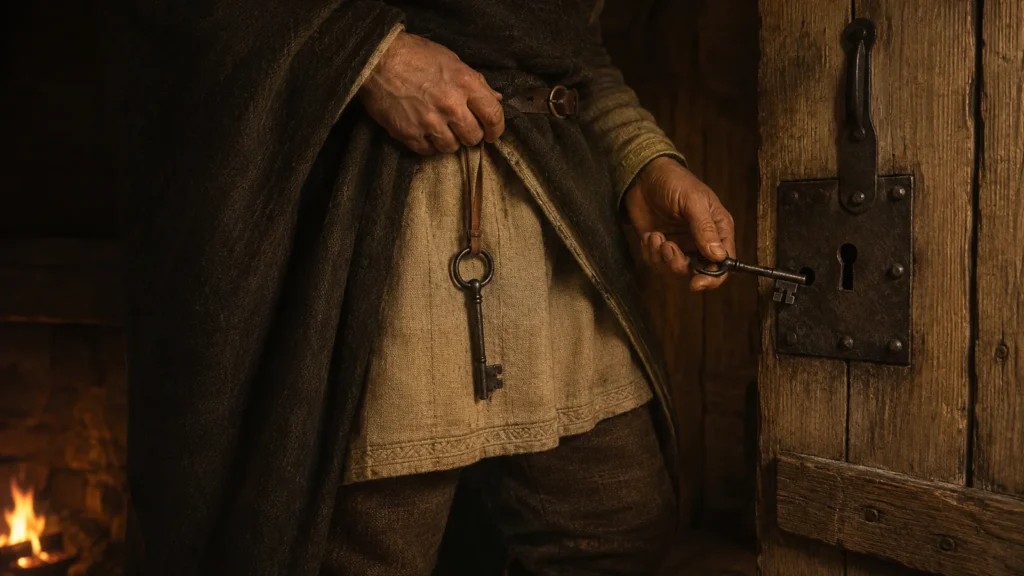
Exeter Book Riddle 44 is arguably the most suggestive riddle of them all.
A curious thing hangs at a man’s thigh, beneath his lord’s garment. In its front is a hole. It is stiff and hard, and holds a good position. When the man lifts his clothing above his knee, he means to greet, with the head of the thing hanging there, that familiar hole, the one that matches its length, and that he has filled many times before.
What am I?
Wrætlic hongað
bi weres þeo, frean under sceate.
Foran is þyrel.
Bið stiþ ond heard.
Stede hafað godne.
Þonne se esne
his agen hrægl ofer cneo hefeð,
wile þæt cuþe hol mid his hangellan
heafde gretan þæt he efenlang ær
oft gefylde.
This is Exeter Book Riddle 44, copied by the manuscript’s principal scribe in the later tenth century and preserved on folio 112v. The Old English is every bit as suggestive as the translation.
Give it a moment before scrolling.
The usual solution
The generally accepted answer is a key and a lock.
Once you know the solution, the riddle resolves neatly: a key hangs from the belt, enters a lock, and fills a hole that it has filled many times before.
The riddle belongs to a small group of Exeter Book riddles built around sexual double meaning, including the famously suggestive riddle usually solved as an onion. Scholars take these riddles seriously because they reveal that sexual humour, bodily imagery, and misleading descriptions were all familiar features of Anglo-Saxon literary culture.
An alternative reading
A dagger and its sheath have sometimes been proposed as an alternative solution. A blade hanging at the thigh fits much of the physical description.
The University of Birmingham’s Riddle Ages project records “key and lock” alongside alternatives such as a phallus and a dagger-and-sheath. Key and lock remains the most widely accepted reading, however. It is supported by a broader tradition of medieval and biblical texts that use locks and keys in similarly suggestive ways.
It also fits the riddle’s emphasis on a “familiar hole” that is filled “often.” That sounds more naturally like routine domestic use than the repeated use of a weapon.
Why the numbering differs
If you look for this riddle elsewhere, you may find a different number.
The Krapp–Dobbie edition—the modern standard used here—numbers it Riddle 44. Craig Williamson’s 1977 edition numbers the same riddle Riddle 42.
So, if another source gives a different number for what appears to be the same text, the discrepancy is usually due to the edition being used.
Glossary
- wrætlic (adjective) — wondrous, strange, curious.
- hongian (verb) — to hang.
- wer (noun) — man.
- þeoh (noun) — thigh.
- frea (noun) — lord, master.
- sceat (noun) — cloth, garment, lap.
- þyrel (noun) — hole, opening.
- stiþ (adjective) — stiff, firm.
- heard (adjective) — hard.
- stede (noun) — place, position.
- esne (noun) — servant, man.
- hrægl (noun) — garment, clothing.
- cneo (noun) — knee.
- hol (noun) — hole, hollow.
- heafod (noun) — head.
- gretan (verb) — to greet, touch.
- gefyllan (verb) — to fill.
A new Old English riddle appears regularly, along with a glossary of Old English terms used across the riddles. Follow WULFCRÆFT on social media for the next solution.
Read next
The Exeter Book Riddles: What Anglo-Saxons Found FunnyOnions, storms, dough, a one-eyed seller of garlic — the riddle-poems that prove the Anglo-Saxons had a sense of humour.
Be the first to leave a thought on this essay.
Comments are held for review before they appear.