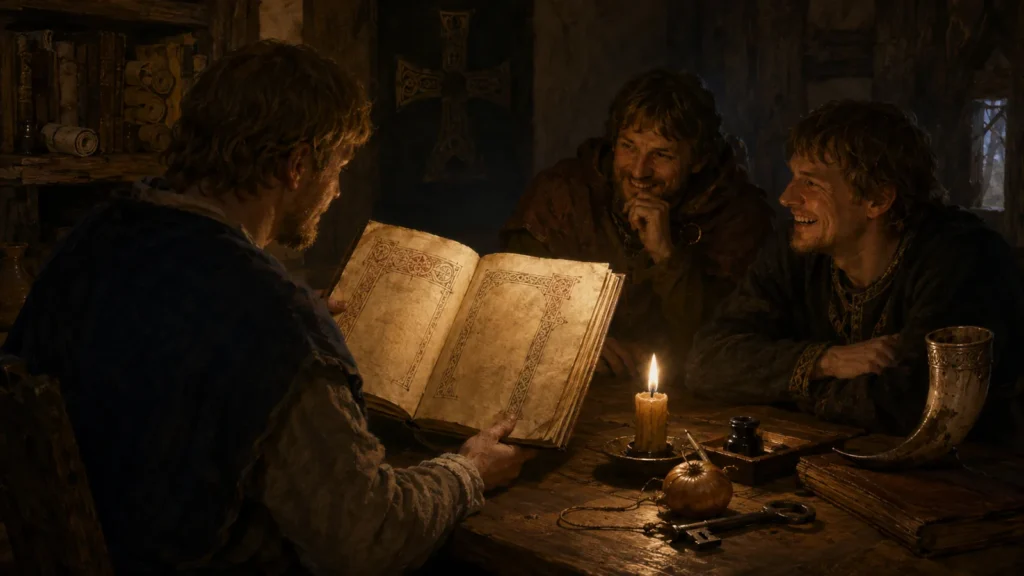
The Exeter Book is the largest surviving collection of Old English poetry, copied by a single scribe around the 960s–980s and given to Exeter Cathedral by Bishop Leofric, who died in 1072, as an mycel englisc boc — “one big English book about various things, made in verse.” Alongside The Wanderer and The Seafarer it preserves roughly ninety-five riddles. None of them comes with an answer (Krapp and Dobbie 1936; Muir 2000).
The manuscript that preserves the greatest poetry of early England spent part of its life as a piece of kitchen furniture. The Exeter Book’s first surviving page carries the ring-stain of a wet vessel set down on it; there are knife scores across the vellum, and a long burn where a brand was laid against the back of the book. Someone used a thousand years of English literature as a coaster, a cutting board and a trivet.
There is something fitting in that, because the book itself refuses to be solemn. Turn past The Wanderer’s frost and exile and you meet a crowd of small voices — an anchor, an iceberg, a one-eyed garlic seller — each demanding, in the closing formula of the genre, saga hwæt ic hatte: “say what I am called.”
The scribe wrote no answers. A riddle with a printed solution is furniture; a riddle without one is a game, and the game is the point. These are poems designed to be argued over on a bench, in company — and some of them are designed to make the company blush.
The Onion Problem
Riddle 25 introduces itself as a wonderful creature, a joy to women, useful to the neighbours. It stands tall in its bed, it says; it is shaggy underneath. And then:
“Sometimes a beautiful churl’s daughter, a proud-minded woman, dares to take hold of me, rushes my redness, ravages my head, clamps me fast. She soon feels what meeting me means — the woman with braided hair. Wet will be her eye.”
The answer is an onion. Of course it is. But the poem has already made you produce the other answer yourself, silently, and that is the mechanism of the joke: the riddle stays innocent while the audience convicts itself. The same trap is set by the boneless thing that swells under a cloth while a woman kneads it (dough, Riddle 45) and by the stiff instrument a lady seizes from its hanging place and puts to work (a key, Riddle 44).
Remember who preserved these. The Exeter Book was copied in a monastic scriptorium and given to a cathedral by its bishop. Whoever bound the collection saw no contradiction between the whale-road and the innuendo — which tells you the culture found laughter and learning perfectly compatible.
The Monster Who Sold Garlic
Not all the humour is bawdy. Some of it is pure misdirection. Riddle 86 announces a prodigy arriving where men sat drinking:
“A creature came walking where men sat at wine, wise in council. It had one eye and two ears, two feet and twelve hundred heads, a back and a belly, two hands, arms and shoulders, one neck and two sides. Say what I am called.”
The accepted solution: a one-eyed seller of garlic, his twelve hundred “heads” hanging in ropes from his shoulders. The riddle builds a Grendel and delivers a market trader. In a literature famous for monsters at the door, that reversal is the joke — the thing shambling into the hall is just a man trying to make a living.
The collection’s wit can turn inward, too. In Riddle 47 a moth eats words — a thief in darkness swallowing a great man’s song — and is “not a whit the wiser” for the wisdom it devoured. Every student who has skimmed a set text has met that moth. And in Riddle 26 a creature tells, tenderly, how it was killed, soaked, scraped and cut so that men might bind it in boards and gold: a calf becoming a gospel book, the animal narrating its own martyrdom into scripture. The same trick of speaking things — used for a laugh in the onion — here produces something close to reverence.
Why It Still Matters
The riddles matter because they let us hear a register the grand poems screen out. The people who imagined the mere and the whale-road also giggled at vegetables, groaned at puns and enjoyed watching a friend walk into a trap of his own dirty mind. A culture’s jokes are the most perishable thing about it; here, uniquely, a whole book of them survived.
They also teach us how that culture thought. A kenning is a riddle folded small — the sea is the whale-road, the body a bone-house — and a riddle is a kenning unfolded to breaking point. To read them is to watch the Anglo-Saxon imagination doing with delight what its greatest poetry does with grief: looking at the ordinary world until it becomes strange, and naming it sideways.
The monks kept the jokes. That may be the most humane fact we own about early England.
Nothing about the riddles is quite stable, beginning with how many there are: the manuscript marks no numbers, so editions disagree — Krapp and Dobbie count 95, Williamson 91, and this essay follows the Krapp–Dobbie numbering used by most anthologies. Solutions are modern proposals, not medieval facts; a few riddles have collected a dozen candidate answers each, and some (like the notorious Riddle 74) remain genuinely open. Even the double entendres have a scholarly literature, which asks whether the “innocent” solution is really the true one or a polite alibi. The honest position is that the game the scribe set a thousand years ago is still running, and we are still players.
Read next
The Key at a Man’s Thigh: Exeter Book Riddle 44A familiar object becomes a suggestive puzzle in Exeter Book Riddle 44. Read the Old English, weigh the clues and explore its playful double meaning.
Be the first to leave a thought on this essay.
Comments are held for review before they appear.